
Steel Rail:Manufactured for Performance
From railway mainlines to heavy-duty crane tracks — Glory Rail supplies hot-rolled steel rails across all major international standards. Custom cutting, drilling, and profiling available. ISO 9001 certified, exported to 50+ countries.

What Is Steel Rail?
Steel rail is a hot-rolled steel profile engineered to support and guide wheeled equipment — from high-speed trains and freight locomotives to overhead cranes and mining carts. Its specialized I-beam-like cross-section distributes enormous vertical and lateral loads into the track structure below, providing a smooth, continuous running surface that can withstand repeated impact over decades of service.
The performance of a steel rail is determined by three factors: profile design (cross-sectional geometry), steel grade (chemical composition and heat treatment), and manufacturing quality (rolling tolerance and surface finish). Matching these factors to your application ensures safety, longevity, and cost-efficiency.
- Railway rails — mainline, metro, light rail transit, and industrial light rail
- Crane rails — DIN 536 (A-series) and QU-series for gantry and overhead cranes
- Special rails — ASCE, UIC, AREMA, BS, and grooved rails
- Flat bar rails — light-duty equipment tracks and custom profiles


Rail Structure
Rail head: The top part directly in contact with wheels, engineered for high wear resistance;
Rail web: The middle connecting part that transfers loads from the head to the base, with its thickness determining overall structural rigidity;
Rail base: The bottom part that distributes loads to sleepers and the track bed, ensuring stable placement.
What Types Of Steel Rail Can Glory Rail Provide?


Railway rails
Railway rails are the primary track components used in railway transportation systems. They are generally divided into light rails and heavy rails, produced according to standards such as GB, DIN, ASTM, EN, and JIS.
Light rails are commonly used in mines, workshops, factories, and temporary track systems. Heavy rails are designed for main railway lines, metro systems, and light rail transit, where higher strength and long service life are required.
DIN536 crane rail
DIN 536 crane rails follow the German DIN 536 standard, one of the most widely used specifications for crane rail systems worldwide. The standard defines the rail profile, dimensions, and quality requirements for heavy-duty crane operations.
These rails are widely used in steel mills, ports, shipyards, and large industrial workshops. Common models include A45, A55, A65, A75, A100, and A120, designed for high load capacity and stable crane movement.
QU crane rail
QU crane rails are manufactured according to the Chinese YB/T 5055 standard, which specifies technical requirements for crane track systems used in industrial environments.
They are mainly used for crane trolley tracks and crane traveling rails in factories and heavy equipment facilities. Standard sizes include QU70, QU80, QU100, and QU120, providing reliable support for material handling operations.
Flat bar rail
Flat bar rails use flat steel or square steel sections as the running track for equipment. This type of rail system features simple installation, flexible design, and lower cost, making it suitable for light-duty industrial applications.
Common sizes include 40×30, 50×30, 60×40, 65×40, 70×40, 75×40, 80×40, 90×40, 100×60, and 100×100 mm, widely used for machinery tracks, workshop equipment, and customized industrial rail systems.
Steel Rail Standards & Specifications
Different regions and applications call for different rail standards. Below is a reference table covering the major international steel rail standards and their typical models. Glory Rail can supply rails to any of these specifications.
| Standard | Region / Origin | Common Rail Models | Weight Range | Typical Application |
|---|---|---|---|---|
| GB / TB | China | 8kg, 12kg, 15kg, 22kg, 24kg, 30kg, 38kg, 43kg, 50kg, 60kg, 75kg | 8–75 kg/m | Mining, industrial, mainline railway, metro |
| DIN 536 | Germany | A45, A55, A65, A75, A100, A120, A150 | 22–150 kg/m | Heavy-duty crane tracks (ports, steel mills) |
| EN 13674 | Europe | 45E1, 49E1, 50E2, 54E1, 60E1, 60E2 | 45–60 kg/m | High-speed and conventional railway |
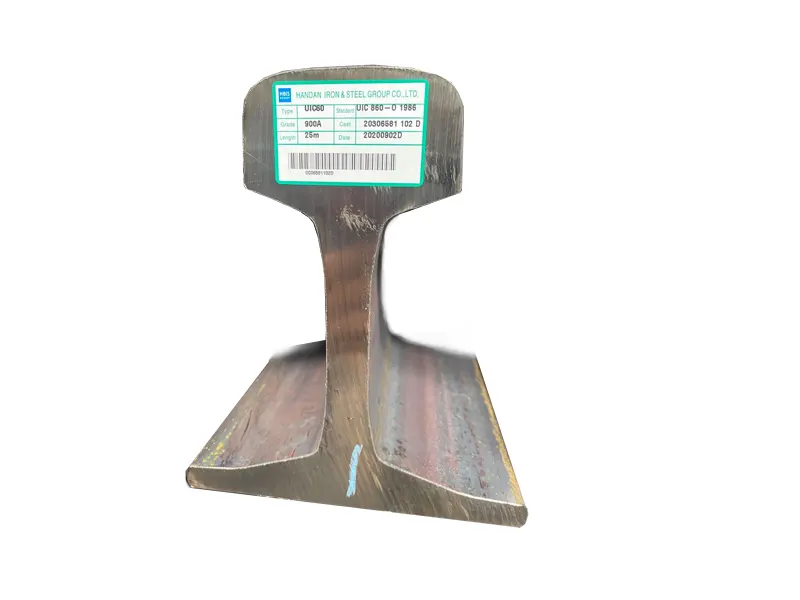
| UIC 860 | International (UIC) | UIC54, UIC60 | 54–60 kg/m | International railway mainlines |
| AREMA | North America | 90RA, 100RE, 115RE, 132RE, 136RE | 45–68 kg/m | North American freight and transit railways |
| ASTM A759 | USA | TR45, TR50, TR57, TR68, CR175 | 45–68 kg/m | American standard rails and crane rails |
| JIS E1101 | Japan | 22kg, 30kg, 37kg, 40kg, 50kgN, 60kg | 22–60 kg/m | Japanese railway and industrial rails |
| BS 11 | United Kingdom | BS75A, BS90A, BS100A | 37–50 kg/m | British railway and industrial applications |
| GOST R51685 | Russia & CIS | R50, P50, R65, P65, R75 | 50–75 kg/m | Railway in extreme climate conditions |
| AS 1085 | Australia | AS50, AS60, AS68 | 50–68 kg/m | Australian heavy-haul and mining railways |
| YB/T 5055 | China | QU70, QU80, QU100, QU120 | 38–120 kg/m | Chinese standard crane rails |
| EN 14811 | Europe | 59R2, 60R2 | ~40 kg/m | Grooved rails for tram and streetcar networks |
Don’t see your required standard? Contact us — we supply to additional specifications including ISCOR, ASCE, and custom profiles.
Steel Rail Grades & Mechanical Properties
The steel grade determines tensile strength, hardness, and wear resistance. Choosing the right grade is critical for matching rail performance to your axle loads, traffic volume, and expected service life.
| Steel Grade | Carbon (%) | Manganese (%) | Tensile Strength (MPa) | Hardness (HB) | Typical Application |
|---|---|---|---|---|---|
| U71Mn | 0.65–0.76 | 1.10–1.40 | ≥ 880 | 260–300 | Mainline heavy rail (Chinese standard) |
| U75V | 0.67–0.77 | 0.70–1.05 | ≥ 980 | 280–320 | High-speed and heavy-duty railway lines |
| 900A | 0.60–0.75 | 0.80–1.20 | ≥ 880 | 248–285 | DIN/EN crane rails and European railway |
| 55Q | 0.50–0.60 | 0.60–0.90 | ≥ 685 | 197–241 | Light industrial and mining rails |
| Q235B | 0.12–0.20 | 0.30–0.70 | 375–460 | 137–187 | Flat bar rails, mining, temporary tracks |
| 50Mn | 0.48–0.56 | 0.70–1.00 | ≥ 645 | 220–260 | Heavy railroad and A-series crane rails |
| U77MnCr | 0.71–0.80 | 0.80–1.10 | ≥ 980 | 290–330 | Premium grade for extreme axle loads |
How to Choose the Right Steel Rail
Selecting the correct steel rail means matching rail specifications to your operating conditions. These six factors determine which rail type, grade, and standard will deliver optimal performance and value.
Axle Load & Wheel Pressure
The maximum load per axle dictates rail weight class. Light rails (8–30 kg/m) handle axle loads up to ~15 tons. Heavy rails (38–75 kg/m) support 25+ ton axle loads. Crane rails (A45–A150, QU70–QU120) are designed for concentrated point loads from crane wheels.
Traffic Volume & Speed
High-traffic mainlines and high-speed railways demand premium grades (U75V, U77MnCr) with superior wear resistance and fatigue life. Low-traffic industrial tracks can use standard grades (U71Mn, 55Q) cost-effectively.
Environmental Conditions
Coastal and corrosive environments may require additional surface protection. Extreme cold climates (GOST standard rails) need impact-tested steel. High-temperature environments (steel mills) demand heat-resistant grades and proper expansion joints.
Standard & Compliance Requirements
Your project specification, local regulations, or end-user requirements may mandate a particular standard (AREMA for North America, EN for Europe, GB for China). We supply to all major standards with full mill test certificates.[3]
Rail Length & Custom Processing
Standard rail lengths range from 6m to 25m. Custom cutting to specific lengths, drilling for fishplate connections, and special end profiling for welding are available. Plan your order to minimize waste and joints.
Budget & Total Cost of Ownership
Higher-grade rails cost more upfront but reduce maintenance, downtime, and replacement frequency. For high-traffic applications, the life-cycle cost of premium grades is typically lower than standard grades over a 20–30 year service life.
How We Deliver The Right Steel Rail
From inquiry to shipping, our five-step process ensures you receive the optimal steel rail for your operating conditions.
Inquiry & Consultation
Share your project specs — our engineers recommend the optimal rail type and grade.
Quotation & Sample
Receive a detailed quote with pricing, lead time, and technical data. Samples available.
Production & Processing
Rails rolled to standard, then custom-cut, drilled, and treated at our facility.
Quality Inspection
Full testing with mill certificates. Third-party inspection on request.
Packing & Shipping
Seaworthy packaging, export documentation, and global logistics to your site.
Glory rail steel Rail Supply


Request Your Custom Steel Rail Quote
We are an experienced supplier of steel rail products with a proven track record across the United States, Latin America, Southeast Asia and the Middle East. Partnering with top Chinese steel mills and operating our own processing facility, we ensure material quality and offer custom services (cutting, drilling, special profiling) to meet project-specific requirements. We’d be glad to share samples, test reports and delivery options for your project.