
Continuous Rail Pads
Product Overview
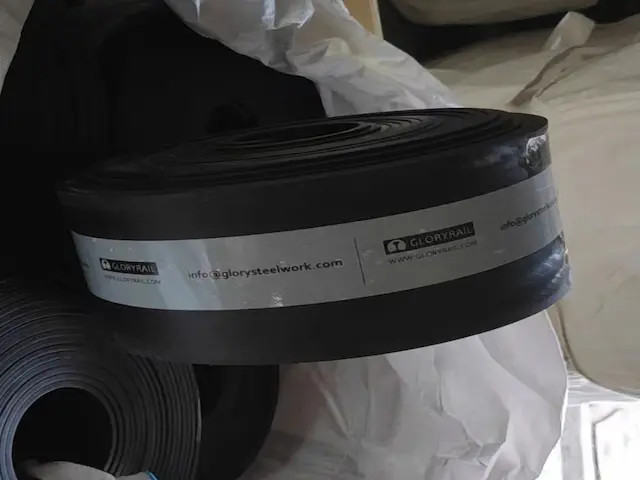
Continuous Rail Pads are heavy-duty shock-absorbing solutions designed for continuous rail support systems in port cranes, shipbuilding, and industrial applications. Available in two premium materials—Nitrile Butadiene Rubber (NBR) and Styrene Butadiene Rubber (SBR)—these pads feature embedded steel reinforcement for lateral stability and long-term durability. Engineered with grooved surfaces and vulcanized steel strips, they mitigate vibration, reduce noise, and distribute wheel loads to extend rail and foundation lifespan.


Material Types & Technical Advantages
Nitrile Butadiene Rubber (NBR)
- Key Properties:
- Superior oil resistance, abrasion durability, and oxidation resistance.
- Temperature tolerance: -25°C to 100°C, suitable for harsh industrial environments.
- Surface grooves enhance adhesion to supports, minimizing wear and sliding.
- Steel Reinforcement:
- Thin steel strips embedded during vulcanization, acid-washed and sandblasted for strong bonding.
- Ensures high lateral stiffness to prevent under-rail movement while allowing rollable transportation.
- Performance Data:
- Shore hardness: 75±5
- Tensile strength: 12.7 N/mm² (12.7 MPa)
- Elongation: 255% (200% after aging)
Styrene Butadiene Rubber (SBR)
- Key Properties:
- Excellent wear resistance, compression proof, and UV stability.
- Similar temperature range (-25°C to 100°C) with enhanced flexibility in cold conditions.
- Grooved surface design for secure contact with supports.
- Steel Reinforcement:
- Identical steel strip integration as NBR, ensuring consistent structural rigidity.
- Width of steel strips proportional to pad width for balanced load distribution.
- Performance Data:
- Shore hardness: 75~80
- Tensile strength: 27.3 MPa
- Elongation: 234%
- Choose NBR for environments with oil exposure (e.g., machinery workshops).
- Choose SBR for general industrial use requiring balanced wear resistance and flexibility.
Design Features & Functionality
- Grooved Surface Technology
- Deep grooves on the pad surface ensure tight contact with supports, reducing abrasion and preventing lateral displacement under dynamic loads.
- Steel Strip Reinforcement System
- Thin, high-strength steel strips are embedded inside the rubber to:
- Increase resistance to crushing and widening.
- Maintain transverse rigidity even in extreme operating conditions.
- Allow the pad to be rolled for efficient transportation without damage.
- Thin, high-strength steel strips are embedded inside the rubber to:
- Load Distribution Optimization
- Spreads concentrated wheel loads over a wider area, reducing pressure on concrete foundations and minimizing fatigue stress.
- Dampens irregular contact between rails and supports, protecting crane mechanisms and extending wheel/axle lifespan.
Applications
- Ports & Wharves: Container cranes, ship-to-shore (STS) cranes.
- Heavy Industry: Steel plants, coking plants, cement factories.
- Shipbuilding: Dockside rail systems for heavy lifting.
- Logistics & Warehousing: High-capacity overhead crane installations.
Technical Specifications Comparison
| Parameter | NBR (MK7 Series) | SBR (MK7 Series) |
|---|---|---|
| Material Type | Nitrile Butadiene Rubber | Styrene Butadiene Rubber |
| Shore Hardness | 75±5 | 75~80 |
| Tensile Strength | 12.7 MPa | 27.3 MPa |
| Elongation | 255% (200% after aging) | 234% |
| Temperature Range | -25°C to +100°C | -25°C to +100°C |
| Vibration Reduction | 45%~50% | 40%~50% |
| Noise Reduction | 12 dB | ≥10 dB |
| Steel Reinforcement | Vulcanized steel strips | Vulcanized steel strips |
| Standard Length | 12 m (customizable) | 12 m (customizable) |
| Available Widths | 98mm, 118mm, 128mm, 134mm, 147mm, 157mm, 168mm, 195mm, 215mm | 98mm, 118mm, 128mm, 134mm, 147mm, 157mm, 168mm, 195mm, 215mm |
Installation Instructions
- Sizing & Cutting
Pads should be 5mm narrower than the supported rail to avoid interference.
Standard 12m lengths can be cut with a hacksaw or jigsaw to match rail dimensions.
Minimum installed length: Should not be less than the spacing between three pairs of rail fixing clips.
- Surface Preparation
Ensure the supporting area is clean, oil-free, and free of protrusions that could damage the pad.
Avoid painting the steel structure beneath the pad for optimal adhesion.
- Installation Steps
Place the pad with flutes (grooves) facing upward for proper load distribution.
When welding rails, remove the pad under the weld zone or use a thermal barrier to protect against heat damage.

Customization & Ordering
- Standard Models: Available in 9 widths (98mm to 215mm) for quick delivery.
- Tailored Solutions:
- Custom widths/thicknesses to match specific rail profiles.
- Special materials (e.g., flame-retardant blends) for hazardous environments.
- Pre-cut lengths for modular installations.
- Sample Policy: Free samples available upon request for material testing.