
Individual Rail Pads
Introduction
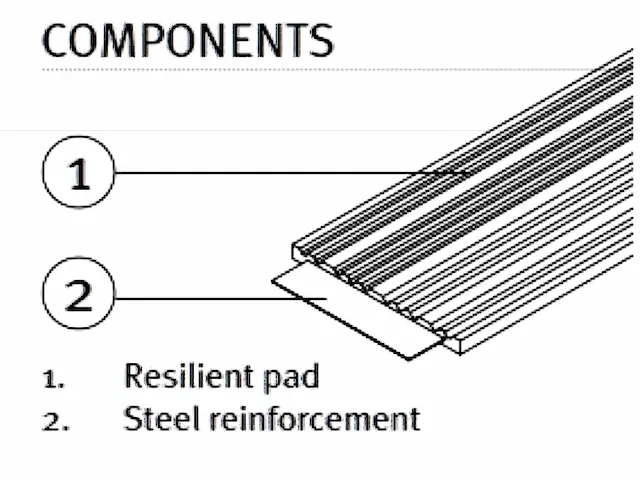
Individual rail pads from Glory Rail are specialized shock-absorbing components designed for crane rail systems, available in three material types: SBR, NBR, and EVA. As one of the two primary pad types (the other being continuous rail pads), individual pads are engineered for “soft-mount” installations with intermittent supports. SBR and NBR variants feature internal steel reinforcement for enhanced lateral stability, while EVA pads offer lightweight flexibility for low-load applications.


Material Types & Advantages
1. Styrene Butadiene Rubber (SBR)
- Key Features: Abrasion-resistant, compression-proof, oxidation-resistant, UV-stabilized, and oil-resistant. Grooved surface ensures superior adhesion to supports, reducing wear.
- Steel Reinforcement: Embedded steel strips, acid-washed and sandblasted for vulcanization bonding, enhance resistance to crushing and lateral movement.
- Application: Ports, wharves, shipbuilding, and heavy industrial environments.
2. Nitrile Butadiene Rubber (NBR)
- Key Features: Excellent oil resistance, wear durability, and wide temperature tolerance (-25°C to 100°C). Double-textile structure provides transverse rigidity.
- Steel Reinforcement: Thin steel strips proportional to pad width allow rollable transportation while preventing under-rail displacement.
- Specifications: Shore hardness 75±5, tensile strength 12.7N/mm², elongation 255% (200% after aging).
3. Ethylene-Vinyl Acetate (EVA)
- Key Features: Lightweight (30% lighter than rubber), low compression set, and high flexibility for minor rail misalignments.
- Design: Steel-free elastic structure for easy cutting and installation, ideal for noise-reduction or low-load scenarios.
Design & Functionality
- Grooved Surface: Enhances friction with supports, minimizing sliding wear under dynamic loads.
- Steel Strip Reinforcement (SBR/NBR):
- Prevents lateral rail displacement and ensures long-term stability.
- Thin steel design balances rigidity with transportability (rollable).
- Load Distribution: Spreads wheel loads over a wider area, reducing fatigue stress on concrete foundations.
Applications
Heavy Industry: Port cranes, steel plants, coking plants, and logistics hubs.
Light Industry: Warehouse overhead cranes, workshop hoists, and sortation systems.
Special Environments: Wet docks, oily workshops, and outdoor rail installations (NBR/SBR preferred for weather resistance).
Installation Guidelines
- Sizing: Pads should be 5mm narrower than the rail to avoid interference.
- Cutting: Use a hacksaw or jigsaw for precise length adjustment; EVA pads can be cut with a utility knife.
- Surface Prep: Ensure supports are clean, oil-free, and free of protrusions. Avoid painting steel structures beneath pads for optimal adhesion.
- Welding Protection: Remove pads under weld zones or use thermal barriers to prevent heat damage.
Note: EVA specifications are based on prior product lines; contact us for detailed technical sheets.
| Parameter | SBR (MK7 Series) | NBR (MK7 Series) | EVA (MK2 Series) |
| Shore Hardness | 75~80 (Shore A) | 75±5 | 95 |
| Tensile Strength | 27.3 MPa | 12.7 N/mm² | 16 MPa |
| Elongation | ≥340% | 255% (200% after aging) | (at break)750% (ISO R 527 standard) |
| Temperature Range | -25℃ to 100℃ | -25℃ to 100℃ | -25℃ to 75℃ |
| Vibration Reduction | 40%~50% | 45%~50% | 35%~45% |
| Noise Reduction(dbA) | ≥10% | 12% | 8~10 dB |
| Steel Reinforcement | Vulcanized bonding | Vulcanized bonding | None |
| Standard Length | 12m (customizable) | 12m (customizable) | Cut to order (per rail length) |