
Project Type: DIN 536 A100 crane rail replacement with custom corrosion protection
Delivery Date: July 2026
Port of Shipment → Destination: Tianjin Port, China → Singapore (destination port to be confirmed)
Customer Type: Local crane rail supply and installation contractor in Singapore
| Item | Details |
|---|---|
| Goods Supplied | DIN 536 A100 crane rails and accessories |
| Rail Specification | A100 (height 95 × base width 200 × head width 100 mm), 74.3 kg/m |
| Steel Grade | U71Mn |
| Standard Length | 12 m per rail (tip to tip), bevel-cut at both ends |
| Supply Quantity | 780 m / 65 rails, approximately 58 tonnes |
| End Preparation | Both ends bevel-cut |
| Coating System | Sa 2.5 abrasive blasting + three-coat Jotun coating system, with a specified total dry film thickness (DFT) of 240 μm |
| First Coat | Jotacote Universal general-purpose abrasion-resistant epoxy primer (0CL), 80 μm |
| Second Coat | Jotacote Universal N10 general-purpose abrasion-resistant epoxy intermediate coat, 80 μm |
| Third Coat | Jotacote Hardtop XP aliphatic acrylic polyurethane topcoat, 80 μm, RAL 9005 |
| Accessories | A100 rubber rail pads, nuts, washers, and flat washers |
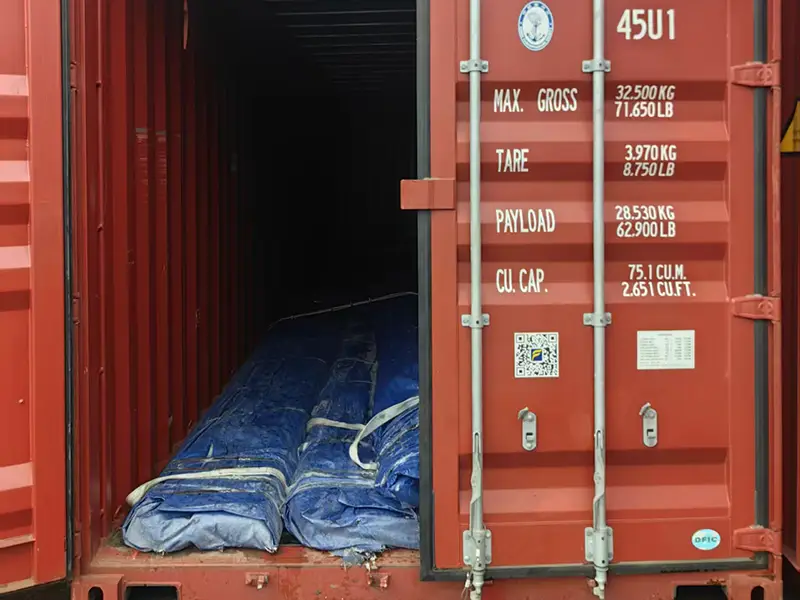
| Packing & Shipping | 40 ft open-top container; rails protected with blue packaging, accessories packed separately in cartons |
| Scope of Supply | Material supply only; on-site installation carried out by the customer’s team |
Project Background and Customer Requirements
The shipyard’s crane rail replacement project is being carried out in phases. Supply for the first phase was completed in early 2025. This shipment covers 780 m of crane rails and accessories for the second phase. See our first-phase A100 crane rail replacement project for details.
Located in an equatorial region with high salt-spray exposure, the shipyard operates its gantry cranes under heavy loads and at high frequency. Corrosion protection and rail surface condition were therefore key requirements for this replacement project. The customer already had its own installation team and provided local supply and installation services. Its requirement was clear: finished, installation-ready rails delivered to site, rather than bare rails requiring secondary processing on site.
For this shipment, A100 crane rail coating was a key part of the supply scope. During technical discussions, the customer focused on three main requirements.
The specified coating system had to be fully implemented. The customer required a three-coat Jotun coating system, with clearly defined requirements for film thickness, color, and intercoat intervals. The shipyard also required coating records for acceptance. Dry film thickness (DFT) measurements had to be documented rather than confirmed verbally.
The quality of the bevel-cut ends was critical. The bevel cuts were intended to provide a smoother transition at rail joints and reduce impact from passing crane wheels. Improperly finished cut edges could become the first areas to develop corrosion and could also affect crane travel smoothness after installation.
Delivery had to meet the shipyard’s maintenance window. The maintenance schedule was fixed, so the rails had to be shipped by the end of July and arrive in August ready for immediate installation.
Glory Rail Engineering Solutions
Applying the Customer-Specified Jotun Three-Coat System and Documenting Each Stage
For this A100 crane rail coating project, the three-coat system was specified by the customer: Jotacote Universal (0CL) primer, Jotacote Universal N10 intermediate coat, and Jotacote Hardtop XP topcoat. Each coat was specified at 80 μm, giving a total specified dry film thickness (DFT) of 240 μm. The topcoat color was RAL 9005. Our responsibility was to apply the specified system consistently at the factory and provide documented inspection records with the shipment.
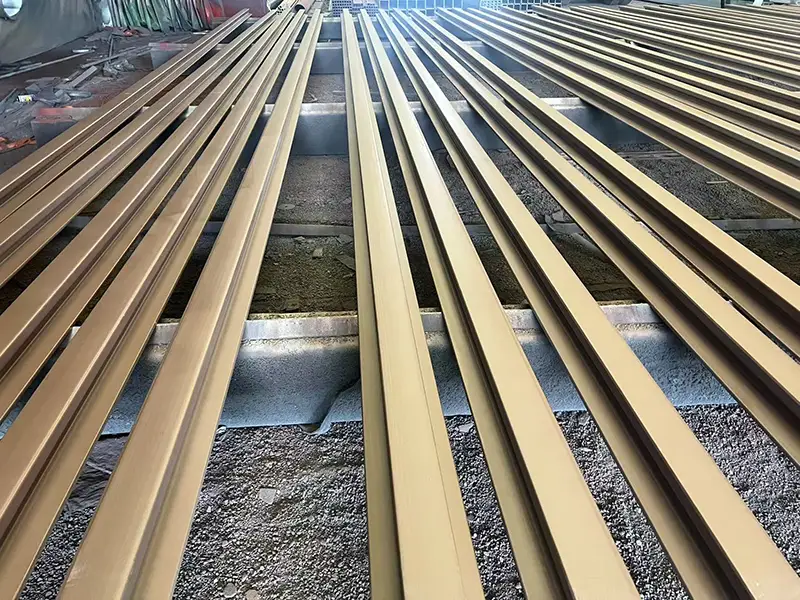
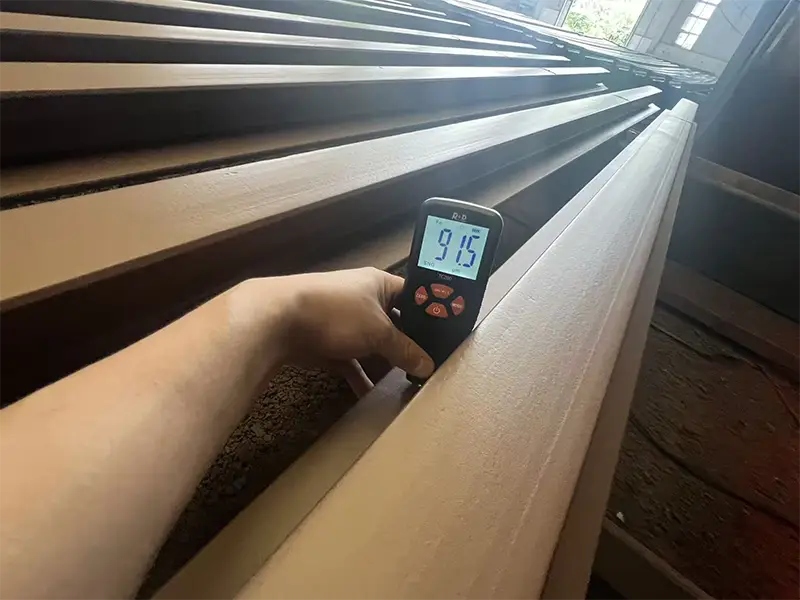
Several process controls were followed. Abrasive blasting had to achieve Sa 2½ cleanliness in accordance with ISO 8501-1. The primer had to be applied within four hours after blasting to prevent flash rusting on the exposed steel surface. Blasting and coating were carried out in the same temperature- and humidity-controlled workshop, with ambient conditions monitored to reduce the risk of blistering and poor coating adhesion.
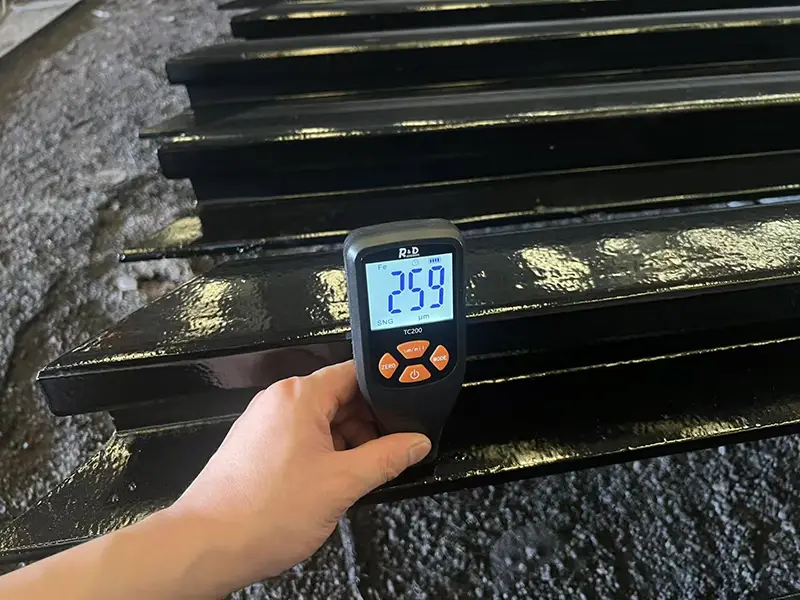
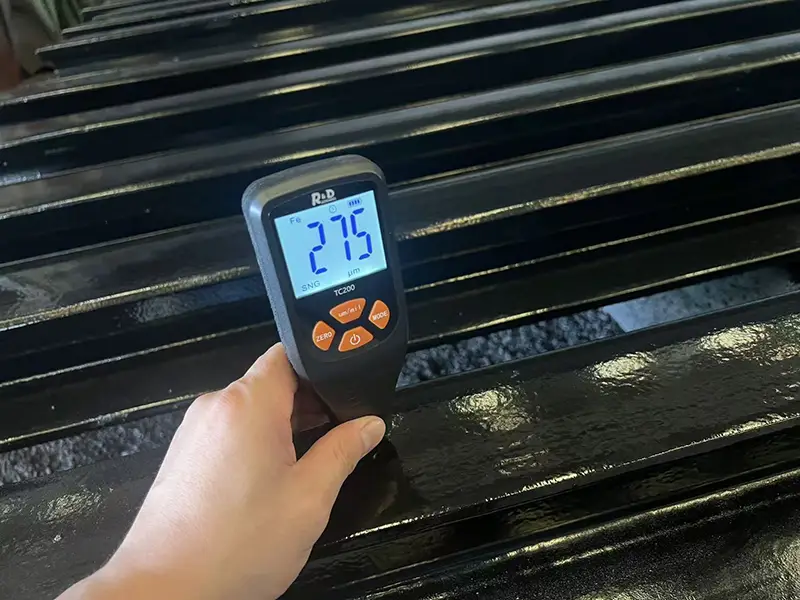
After each coat had dried to the touch, its DFT was measured. Inspections were carried out on individual rails at selected cross-sections. Areas below the specified thickness were recoated and measured again. The RAL 9005 topcoat was applied in the same production batch, with color checks performed to minimize variations between rails.
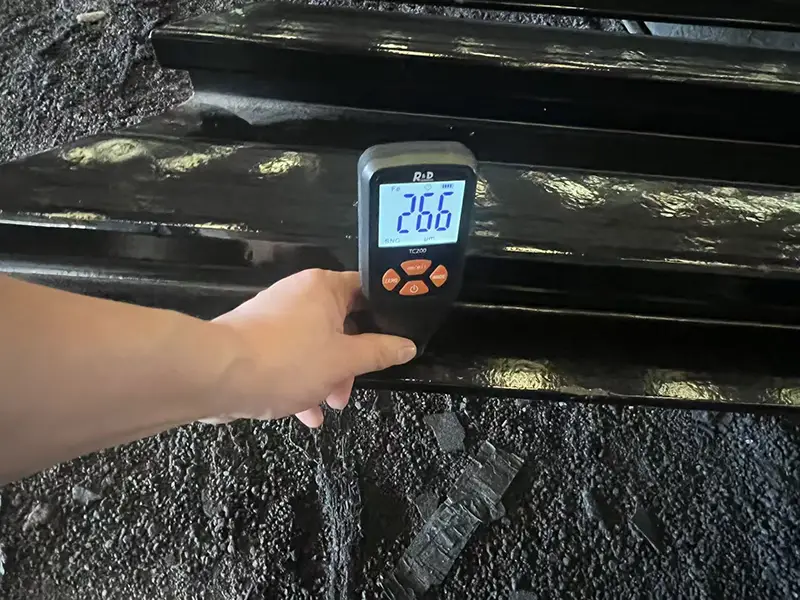
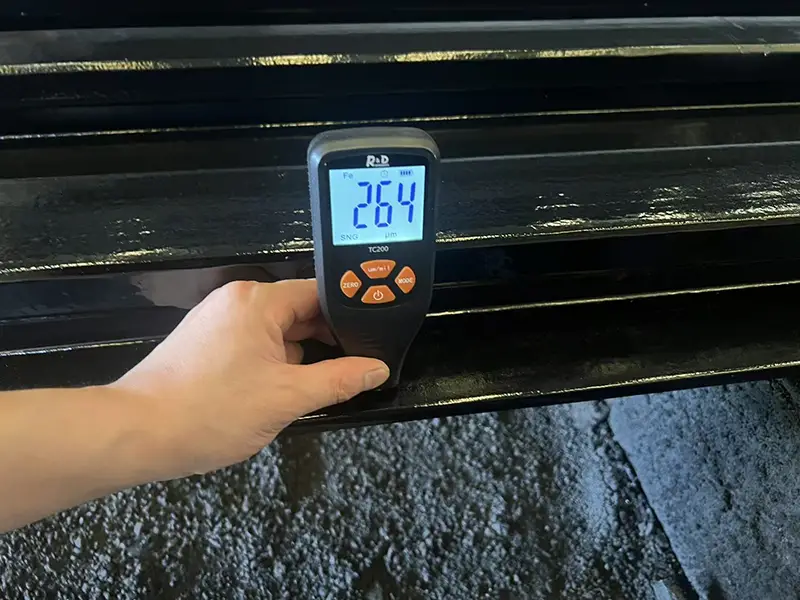
The inspection results were compared against the specified values. An individual coat recorded a spot-check reading of 91.5 μm, above the specified 80 μm. Total DFT readings were 259, 264, 266, and 275 μm, all exceeding the specified total of 240 μm. These readings provided additional coating thickness above the specified target. The coating surface was uniform, with no obvious sagging or orange peel.
Rail-End Bevel Cutting and Welding-Zone Protection
Rail-End Bevel Cutting
The rail ends were bevel-cut to provide a smoother transition at rail joints and reduce the impact of passing crane wheels. This helps minimize vibration and noise during crane operation and improves travel smoothness.
Masking and Protection of Welding Zones
Since the rails are joined by welding on site, the designated welding zones at both ends were left uncoated. Epoxy and polyurethane coatings can burn under welding heat, and their decomposition products may contaminate the weld area and compromise weld quality.
After abrasive blasting, masking film and tape were applied to the designated welding zones before the three-coat Jotun system was applied to the specified rail surfaces, including the rail head running surface. Once the coatings had cured, the masking materials were removed.
Before dispatch, a layer of weldable rust-preventive compound was applied to the uncoated welding zones for temporary protection during ocean transit. The compound can be wiped off before on-site welding.
Open-Top Container Shipping and Packaging
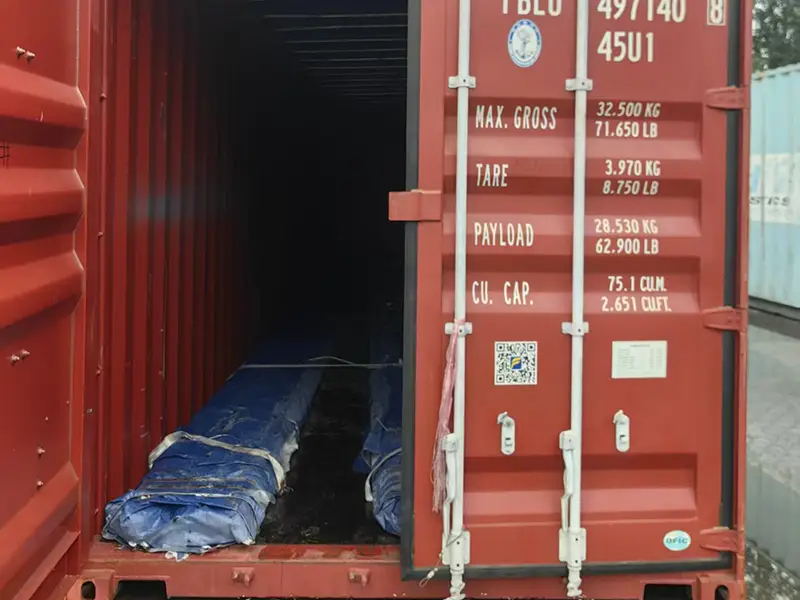
A 40 ft open-top container was selected for this shipment. Although a conventional container can also accommodate 12 m standard-length rails, the open-top option was chosen at the customer’s request to simplify unloading at the destination port. Rail bundles can be lifted directly from above, reducing internal handling and additional lifting operations inside the container.
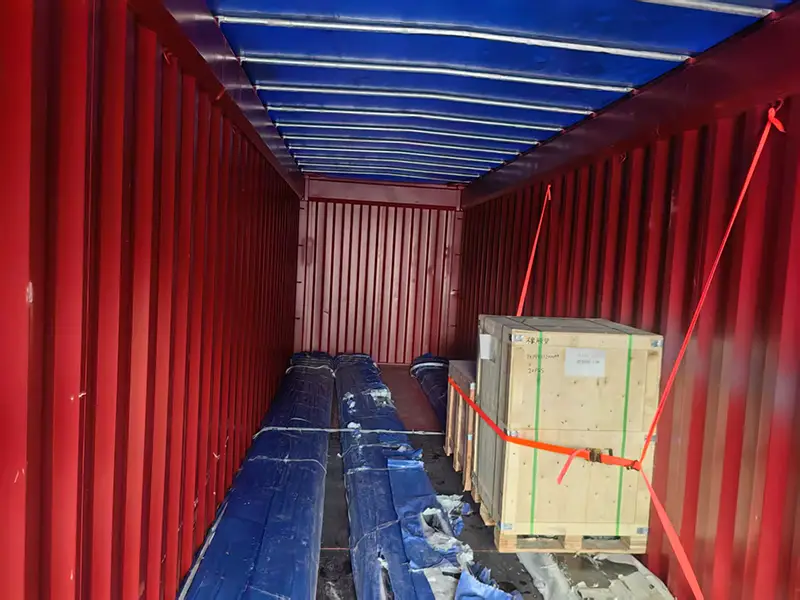
The rails were wrapped in blue protective packaging before dispatch. Extra protection was provided around the bevel-cut ends and wheel-running surfaces to prevent damage to the coating from lifting slings and friction between rail layers.
The rubber rail pads, nuts, washers, and flat washers were packed separately in cartons and shipped separately from the rails, making them easier to identify and retrieve during installation.
Inside the container, the rails were stacked in layers and secured with lashing to prevent movement during transit. The open top was covered with a waterproof tarpaulin to protect the cargo from rain.
Why the Customer Chose Glory Rail
A finished product, not a semi-finished supply.
Steel mills only roll the rails, while coating contractors only apply the paint. When these services are purchased separately, the customer must coordinate transportation between facilities, end processing, coating touch-ups, and repeat DFT inspections. Glory Rail brings rail supply, bevel cutting, abrasive blasting, three-coat coating, inspection, packaging, and export documentation together in one process, delivering rails ready for installation upon arrival.
Coating records supplied with the shipment.
For shipyard projects, acceptance depends not only on coating thickness but also on application records. DFT measurements are recorded for each coat, and color codes, batch numbers, and inspection data are supplied with the shipment. The customer can submit these records to the shipyard as part of the delivery documentation.
Phase Two built on the process established in Phase One.
The same rail lengths and corrosion protection system were used for the second phase, eliminating the need for new sample coating and approval. This reduced preliminary coordination and trial coating time, allowing the shipment to be dispatched by the end of July to meet the maintenance schedule.
Lower overall project costs.
Compared with sourcing bare rails locally and sending them to a third-party coating contractor for additional processing, integrated supply eliminates extra transportation, double handling, and coating touch-ups. This significantly reduces the overall cost of the rail system and shortens the project schedule.
Frequently Asked Questions
Q1: Can the three-coat Jotun system blister during ocean transit through equatorial regions?
The main risks of coating blistering come from inadequate surface preparation and improper intervals between coats. Achieving Sa 2½ surface cleanliness, applying the primer promptly after blasting, and following the coating manufacturer’s specified recoat intervals are essential to preventing blistering. Workshop temperature and humidity must also be controlled during application.
The Hardtop XP topcoat is a room-temperature-curing aliphatic polyurethane that provides weather resistance for marine atmospheric exposure. During shipping, covering the open-top container with a waterproof tarpaulin and preventing water accumulation inside the container also help reduce the risk of coating damage.
Q2: How is the thickness of the three-coat system inspected and accepted?
Inspection generally covers both individual coat DFT and total dry film thickness. Each coat must meet its specified thickness, and the total DFT must meet the overall project requirement. Excessive local build-up should also be avoided, as it may cause sagging or cracking.
Measurements are taken using a magnetic DFT gauge, with readings sampled and recorded at selected cross-sections of individual rails. Areas below the specified thickness are recoated and measured again.
Q3: What should be considered when shipping 12 m crane rails in an open-top container?
The main considerations are cargo securing and rain protection. Rails should be stacked in layers and properly secured between layers and against the container walls to prevent movement during transit. The open top should be tightly covered with a waterproof tarpaulin. Additional protection should be provided around the rail ends and head running surfaces to prevent coating damage during lifting and handling.
The main advantage of an open-top container is at the destination port, where entire rail bundles can be lifted directly from above, reducing internal handling and additional lifting operations.
Contact Glory Rail
For shipyard or port projects requiring crane rails with specified corrosion protection systems, Glory Rail supplies DIN 536 A-series and QU-series rails, as well as finished rail packages with custom bevel cutting, drilling, coating, and accessories.
Glory Rail supplies rails to DIN 536 (A45–A150), QU, JIS, GOST, and other standards. Custom coating systems are available using products from brands such as Jotun, PPG, and International. Shipping options include full-container loads, open-top containers, and breakbulk shipments.
Send your drawings and coating requirements to Glory Rail for a process feasibility assessment and quotation.