
Project Supply Overview
| Item | Project Details |
|---|---|
| Project Type | Flat Bar Rail System |
| Delivery Date | August 2026 |
| Product | Q355B High-Strength Low-Alloy Flat Bars |
| Material Standard | GB/T 1591-2018 |
| 50 × 30 mm | 5.8 m per piece; 148 pcs; unit weight: 11.775 kg/m; total weight: approx. 10.11 tons |
| 60 × 40 mm | 5.8 m per piece; 93 pcs; unit weight: 18.84 kg/m; total weight: approx. 10.16 tons |
| 70 × 40 mm | 5.8 m per piece; 82 pcs; unit weight: 21.98 kg/m; total weight: approx. 10.45 tons |
| Total Weight | Approx. 30.72 tons |
| Custom Processing | 45° bevel cuts at both ends |
| Third-Party Inspection | SGS inspection covering chemical composition and mechanical properties |
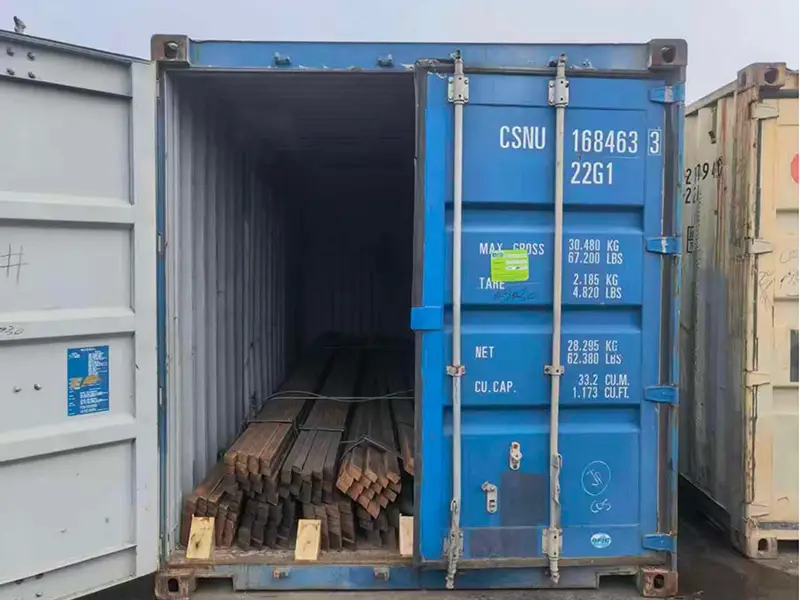
| Shipping Arrangement | One 20-foot standard container for the main shipment, with the remaining cargo shipped via LCL |
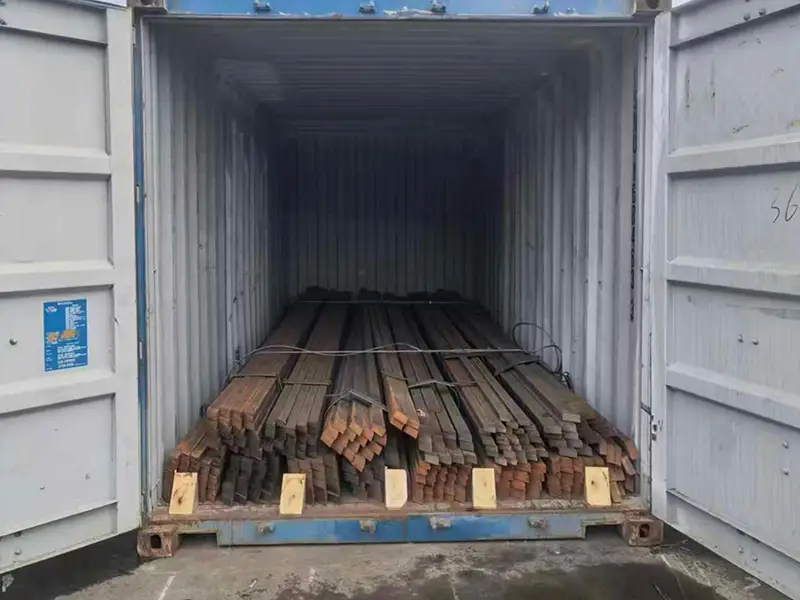
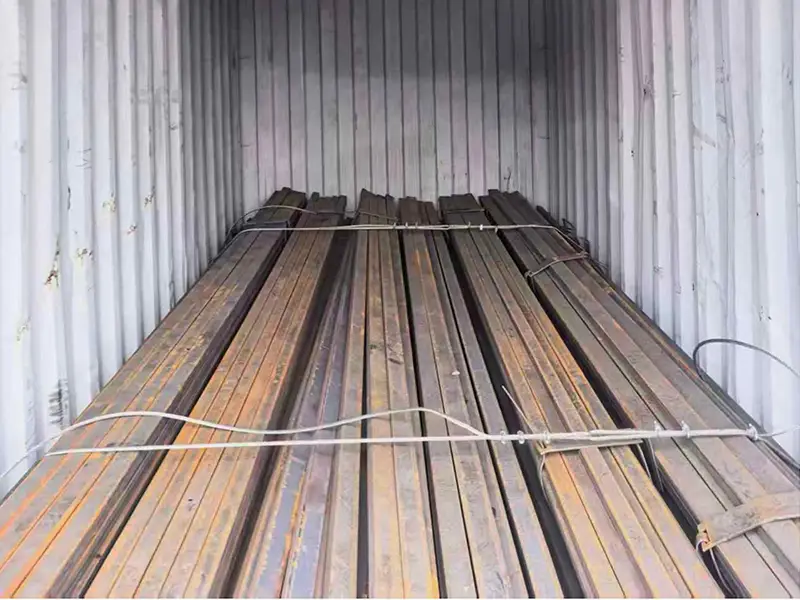
| Surface Condition | Hot-rolled, as-supplied condition with light surface oxidation and loose rust |
| Port of Loading | Tianjin Port, China |
| Destination Port | Port of Napier, New Zealand |
Why Use Flat Bars for Crane Rail Applications?
Typical Applications of Flat Bars and Square Bars as Rails
Flat bars and square bars can be used as running rails or guide rails in certain material handling and lifting applications. A flat bar crane rail arrangement may be suitable where the equipment design and operating loads do not require a conventional crane rail profile.
However, flat bars and square bars differ significantly from standard crane rails, such as QU-series and DIN 536 A-series rails, in cross-sectional geometry, hardness, and wheel-guiding characteristics.
Typical applications include:
- Light-Duty Crane Runways: Small-capacity, low-speed gantry cranes and underhung cranes with relatively low wheel loads, where a dedicated crane rail profile with a specially designed head and base is not required.
- Equipment Guide Rails: Transfer trolleys, automated material handling carts, and warehouse shuttle vehicles, where the rails mainly provide support and guidance. The wheels typically feature V-grooved or flat treads, depending on the track design.
- Temporary or Simple Rail Tracks: Temporary transport tracks for flatbed carts and material handling equipment at construction sites, where a simpler rail arrangement may be sufficient.
Q355B Flat Bar vs. DIN 536 A55 Crane Rail
The customer initially considered DIN 536 A55 crane rails for a customized overhead crane. After reviewing the application requirements and project budget, Glory Rail proposed Q355B flat bars as an alternative. The goal was to find a cost-effective rail solution that could meet the crane’s actual operating requirements without specifying a more specialized rail profile than necessary.
Why Choose DIN 536 A55 Crane Rail?
DIN 536 A55 is a standardized crane rail profile with a specially designed head, web, and wide base. Its key dimensions include a 55 mm head width, 150 mm base width, 31 mm web thickness, and 65 mm overall height. The rail weighs 31.8 kg/m.
The shaped rail head provides a defined wheel-running surface, while the wide base offers a dedicated mounting interface for the rail fastening system. These features make A55 a suitable option for engineered crane runway systems where wheel loads, lateral forces, fastening compatibility, and long-term wear performance need to be carefully considered.
However, the specialized profile also comes with a higher material cost compared with a simple rectangular flat bar.
Advantages of Q355B Flat Bars
For this project, Q355B flat bars offered several practical advantages.
- Adequate Material Strength: Q355B flat bars supplied to GB/T 1591-2018 have a minimum yield strength of 345 MPa for the 30 mm and 40 mm thicknesses used in this project, with a tensile strength of 470–630 MPa. For comparison, the 50Mn material specified in Glory Rail’s A55 product data has a minimum yield strength of 390 MPa and a minimum tensile strength of 645 MPa. Although the 50Mn grade has higher specified strength values, material strength alone does not determine whether a rail profile is suitable. The actual wheel loads and operating conditions must also be considered.
- Lower Weight and Material Cost: A 60 × 40 mm Q355B flat bar weighs only 18.84 kg/m, compared with 31.8 kg/m for an A55 crane rail. This represents approximately 40.8% less steel weight per meter, reducing material consumption and handling weight. It also provides an opportunity to lower the material procurement cost.
- A Comparable Nominal Running Width: The A55 rail has a nominal head width of 55 mm, while the 60 × 40 mm flat bar provides a 60 mm-wide top surface. Their nominal widths are relatively close. However, actual wheel-to-rail contact width and contact stress still need to be verified against the wheel tread geometry and operating loads.
Why Q355B Flat Bars Were Selected for This Project
The customer’s customized overhead crane was designed for medium-capacity lifting and intermittent operation inside a workshop. Under these project conditions, the Q355B flat bar solution offered a practical balance between material performance and procurement cost.
Rather than using a dedicated crane rail profile by default, the customer selected a simpler flat bar crane rail solution that matched the intended application.
DIN 536 A55 remains a suitable choice for crane runway systems requiring its dedicated rail profile and fastening arrangement. Q355B flat bars, on the other hand, can be a cost-effective alternative when the wheel loads, contact stresses, operating cycles, and support design have been properly evaluated.
For this project, the flat bar option helped reduce the nominal steel weight and material procurement cost while meeting the customer’s specified requirements.
Custom Processing and SGS Inspection
45° Bevel Cuts at Both Ends
Unlike standard crane rail connections, flat bar rail joints typically require welding and grinding to achieve a smooth running surface. An appropriate expansion gap should also be allowed for thermal movement. Any height difference or sharp step at the joint can increase wheel impact and accelerate wear.
For this project, the customer’s drawings specified 45° bevel cuts at both ends of each flat bar to create a smoother transition between adjacent rail sections.
Glory Rail used a plasma cutting machine with a custom positioning jig to maintain the bevel angle within 1° of the specified angle. After cutting, the beveled surfaces were ground to remove cutting residue and burrs. This finishing step also helped reduce the risk of rust forming around rough cut edges during ocean transit, minimizing additional cleaning work upon arrival.
SGS Third-Party Material Inspection
The customer required SGS third-party testing for the Q355B flat bars. The inspection covered two main areas:
- Chemical Composition: Analysis of carbon (C), silicon (Si), manganese (Mn), phosphorus (P), sulfur (S), and other specified elements.
- Mechanical Properties: Testing of 0.2% proof strength (Rp0.2), tensile strength (Rm), and elongation after fracture (A).
As part of Glory Rail’s established SGS testing process, test specimens were taken from rolled billets of the same Q355B steel heat. At the steelmaking stage, the mill was also asked to target key chemical elements around the middle of the specified Q355B ranges rather than close to their lower limits.
All items passed the first round of SGS testing. The inspection report can be verified through SGS using its report number.
Flat Bar Rail Fixing Methods
Although this project covered material supply only, the fixing method is an important consideration for the customer’s subsequent installation. Common options include:
Clamp Fixing: Dedicated hold-down clamps can be designed to match the flat bar dimensions and secure the rail to its supporting structure.
Welded Fixing: Flat bars can also be welded directly to embedded steel plates or supporting beams. Welding distortion must be properly controlled during installation.
The appropriate fixing method depends on the supporting structure, operating loads, and installation requirements.
Surface Condition and Protection Recommendations
The Q355B flat bars in this project were supplied in their standard hot-rolled condition. Hot-rolled steel typically retains a layer of mill scale, which may appear dark gray or reddish-brown. Its surface can also have a relatively rough texture, with minor surface marks or indentations. These are common characteristics of the hot-rolling process.
During ocean transportation, temperature fluctuations and condensation inside the container may cause light flash rust to develop on the mill scale and exposed steel surfaces.
The light surface rust observed on this shipment was superficial and did not indicate a change in the base material’s specified mechanical properties. The SGS test results independently confirmed that the tested material met the specified chemical composition and mechanical property requirements.
Before applying the final corrosion protection at the customer’s facility in New Zealand, any loose rust and surface contaminants can be removed as part of the normal surface preparation process. The required preparation method depends on the selected protective coating.
Glory Rail’s standard supply condition is bare, hot-rolled steel without additional surface treatment. For projects with specific surface protection or appearance requirements, customers can request alternative treatments before placing an order, including hot-dip galvanizing, epoxy primer, or oil coating. The appropriate option should be selected according to the operating environment and rail application.
Shipping and Delivery
Split Shipment Arrangement
Napier is a key container port serving New Zealand’s Hawke’s Bay region. Direct sailings to Napier are relatively limited, so careful coordination of the shipping arrangement was required.
With a total cargo weight of approximately 30.72 tons, the shipment was divided into two parts to meet container payload requirements. Glory Rail arranged one 20-foot standard container for the main shipment, with the remaining cargo shipped via LCL (Less than Container Load).
The main container included all 50 × 30 mm and 60 × 40 mm flat bars, along with part of the 70 × 40 mm batch. The remaining 70 × 40 mm flat bars were arranged as LCL cargo.
Although handled under two different shipping arrangements, both the FCL container and LCL cargo were booked on the same vessel and shipped together on the same voyage from Tianjin to Napier.
This arrangement allowed the full shipment to move together while keeping the container loading within its allowable payload.
Shipping and Quality Documentation
The following documents were prepared for the shipment:
- Commercial Invoice
- Packing List
- SGS Material Inspection Report
- Mill Test Certificate (MTC)
- Bill of Lading (B/L)
- Certificate of Origin (CO)
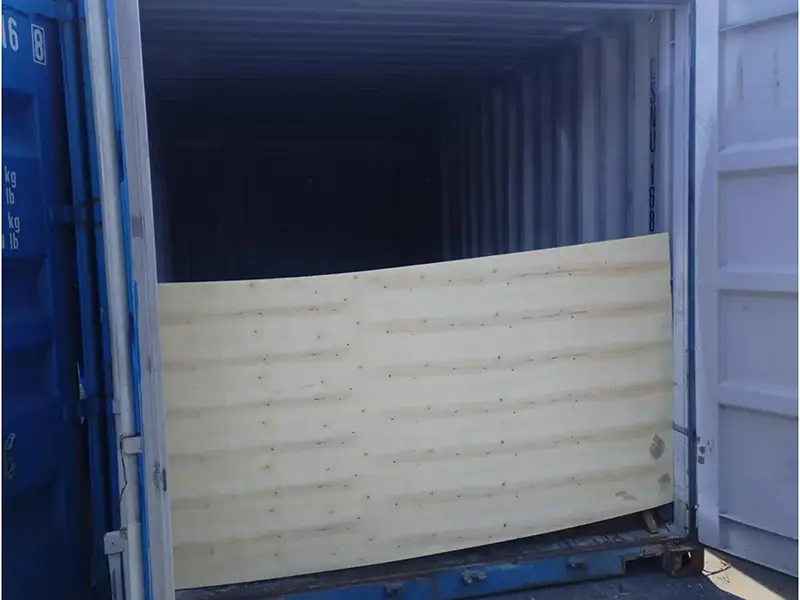
Container Loading Photos
The following photos show the actual loading process, including the arrangement and securing of the flat bars inside the shipping container.
Why the Customer Chose Glory Rail
One-Stop Service with a Single Point of Contact
From arranging steel production in three specifications and 45° bevel cutting to coordinating SGS inspection and split shipments, Glory Rail managed the entire supply process through one point of contact.
Without this arrangement, the customer would have needed to coordinate with multiple suppliers, including a steel mill, processing workshop, inspection agency, and freight forwarder. Instead, all project requirements were coordinated by Glory Rail, simplifying communication and reducing the customer’s workload.
Practical Technical Recommendations
DIN 536 A55 was the customer’s initial choice, but it was not the only viable option for this project. After reviewing the application requirements and budget, Glory Rail recommended Q355B flat bars as a more economical alternative.
Rather than simply recommending a product, Glory Rail explained the differences between the two options and their respective applications. After reviewing the material requirements, the customer accepted the Q355B flat bar solution, achieving lower material procurement costs without specifying a more specialized rail profile than necessary.
Experience with International Project Requirements
For overseas buyers, successful delivery involves more than meeting product specifications. Surface rust during ocean transportation, SGS report requirements, shipping schedules to Napier, and practical installation considerations can all affect the project.
Drawing on experience from hundreds of export projects, Glory Rail addressed these details in advance. This included explaining the expected surface condition and preparation requirements, providing an English-language SGS inspection report, coordinating FCL and LCL cargo on the same vessel, and sharing reference information on flat bar rail fixing methods.
These are part of Glory Rail’s standard approach to managing international steel supply projects, helping customers avoid unnecessary communication and coordination issues.
Looking for a Custom Flat Bar Rail Solution?
Whether you need custom flat bar crane rail materials or are comparing DIN 536 crane rails with Q355B flat bars, Glory Rail can help evaluate the available options based on your project requirements.
Glory Rail provides one-stop support covering technical selection, steel production, custom processing, third-party inspection, and international shipping.
Our flat bar rail product range includes Q235B and Q355B grades, thicknesses of 30–60 mm, widths of 40–100 mm, and custom lengths to suit different project requirements.
Contact Glory Rail to discuss your flat bar rail specifications and project requirements.