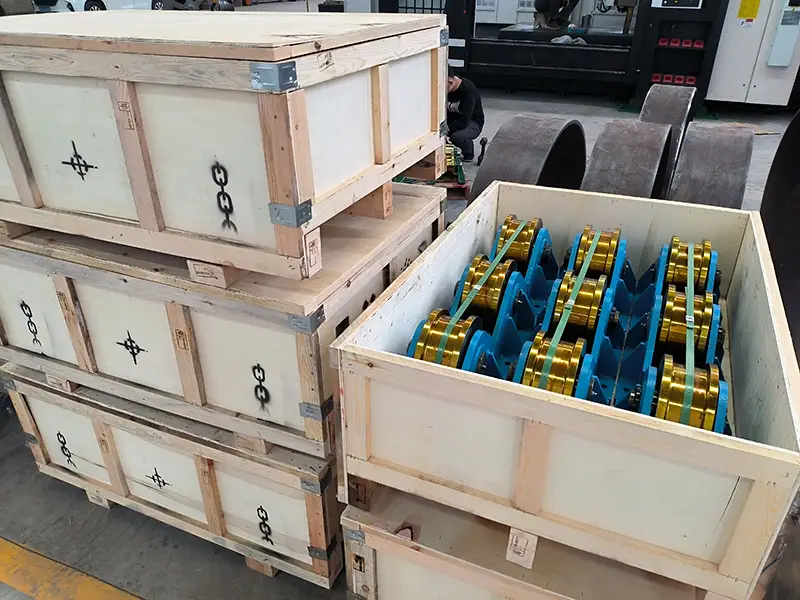
The main types of crane wheels are typically classified based on flange structure, drive function, and assembly design. These include single-flange, double-flange, and flangeless wheels, as well as drive wheels and idler wheels. Each configuration plays a distinct role in supporting the crane’s load, guiding its movement, and transmitting drive power.
When selecting the appropriate crane wheels, it is not only necessary to compare wheel diameters or rated loads, but also to consider track geometry, lateral guidance, operating conditions, and the design of the wheel assembly. This article introduces the main types of crane wheels and their differences, and discusses the key factors to consider when selecting wheels for overhead cranes, gantry cranes, and other material-handling equipment.
How Are Crane Wheels Classified?
Crane wheels are one of the most fundamental yet distinctive components of a crane’s travel mechanism. Unlike chains, which transmit tensile force, or gear reducers, which reduce speed, crane wheels perform three functions simultaneously within a wheel–rail contact area of just a few square centimeters:
- Load-bearing: Transfer the dead weight of the bridge or gantry, trolley weight, rated load, and dynamic loads generated during operation to the rails.
- Travel: Enable the entire crane to move smoothly along the rails through rolling contact.
- Guidance: Use the wheel flanges to constrain lateral movement and prevent derailment.
These demanding functions place much higher requirements on crane wheel materials, heat treatment, and machining precision than those for ordinary industrial rollers. Premature wear, rail side wear (also known as rail gnawing), and even derailment caused by improper material selection can become evident within just a few months of operation.
Precisely because a crane wheel carries multiple responsibilities at once, no single classification dimension can cover every decision point encountered in real engineering selection. Established industry practice is therefore to examine wheel design along three orthogonal dimensions, each chosen independently of the others:
- Classification by flange configuration — this dimension answers the question “does the wheel itself have independent guidance capability?” It is the most common and most intuitive classification method, and it directly determines the wheel’s derailment resistance and friction level.
- Classification by drive function — this dimension answers the question “does the wheel need to transmit motor torque?” It affects the fit type of the wheel bore, the keyway design, and the estimated rate of wear.
- Classification by assembly configuration — this dimension answers the question “in what form is the wheel supplied?” It determines the installation and maintenance approach and the amount of on-site work involved, and the engineering economics of a standalone wheel differ markedly from those of a pre-assembled wheel set.
Types of Crane Wheels by Flange Configuration
The flange is a raised edge on one or both sides of a wheel tread. It helps control the wheel’s lateral position relative to the rail and contributes to stable crane travel.
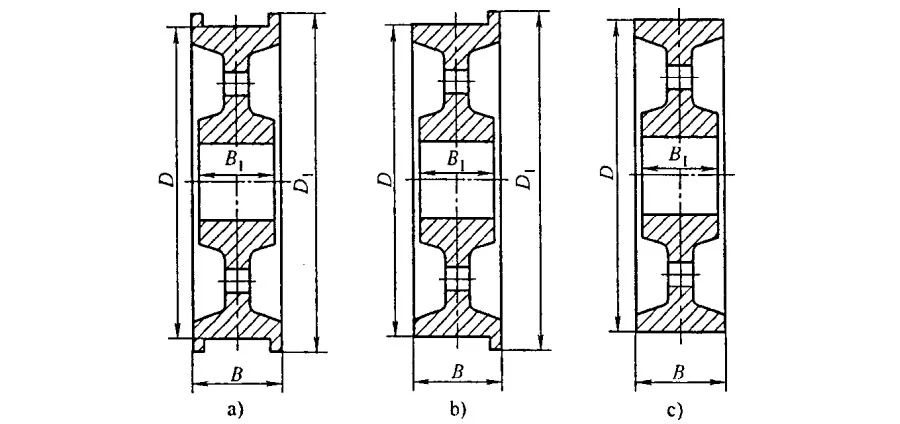
Based on flange arrangement, crane wheels generally fall into three types.
Single Flange Crane Wheels
A single flange crane wheel has a raised flange on only one side of the wheel tread. The flange provides lateral restraint by limiting movement toward one side of the rail.
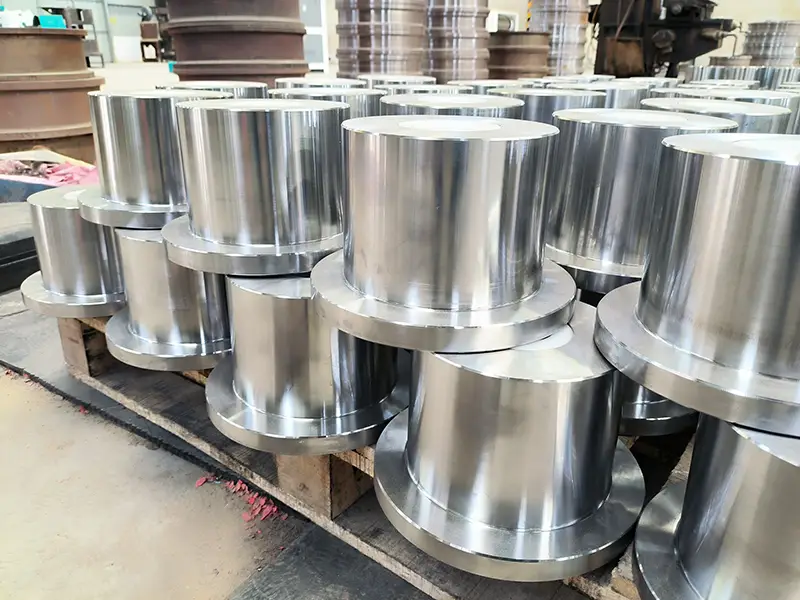
This configuration is used in crane travel systems where the required lateral guidance is achieved through the overall wheel arrangement and track design.
Single-flange wheels can be suitable for certain overhead crane trolleys, bridge crane travel mechanisms, and specialized applications where the equipment layout calls for guidance from one side.
Key characteristics:
- One raised flange provides lateral guidance in a specific direction.
- The wheel arrangement can offer greater lateral flexibility than a double-flange configuration.
- Flange orientation must match the crane’s travel layout and installation drawings.
- Wheel and rail clearances need to be checked to prevent excessive flange contact.
Single-flange wheels should not be selected solely because they have fewer flanges. Their suitability depends on how the complete crane system controls lateral movement.
Double Flange Crane Wheels
A double flange crane wheel has raised edges on both sides of the tread. These flanges run along either side of the rail head and provide lateral guidance in both directions.
Double-flange wheels are widely used in crane travel systems where wheel-level guidance on both sides of the rail is required.
Typical applications include bridge cranes, gantry cranes, and heavy-duty industrial material-handling equipment. The exact configuration depends on rail geometry, wheel spacing, and the crane manufacturer’s design.
Key characteristics:
- Two flanges help restrict lateral movement in both directions.
- The wheel tread runs over the rail head with specified side clearances.
- Flange dimensions must be matched to the rail head width and wheel alignment.
- Excessive side contact can accelerate wear on both the wheel flanges and rail.
A double-flange configuration does not automatically provide better tracking under every operating condition. Incorrect wheel spacing, rail alignment, or clearance can cause continuous flange-to-rail contact and increase wear.
Flangeless Crane Wheels
A flangeless crane wheel has a smooth tread without the traditional raised side flanges.
Unlike conventional flanged wheels, it does not rely on the wheel itself to provide lateral guidance. Instead, the system uses separate guidance components, such as horizontal guide wheels or side rollers, to control the wheel’s position relative to the rail.
This arrangement separates two functions:
- The main wheel tread carries the vertical load and provides rolling contact.
- The horizontal guide wheels manage lateral forces and maintain the required travel path.
Flangeless wheel systems can be considered for automated material-handling equipment, specialized crane travel systems, and applications where flange-to-rail contact needs to be reduced.
However, they require a properly engineered guidance arrangement. Removing the wheel flanges without providing an alternative means of lateral restraint is not a suitable replacement strategy.
The guide-wheel layout, rail geometry, frame stiffness, and installation accuracy must all be considered.
Single Flange vs. Double Flange vs. Flangeless Crane Wheels
The three configurations differ mainly in how they control lateral movement.
| Feature | Single Flange | Double Flange | Flangeless |
|---|---|---|---|
| Flange arrangement | One side | Both sides | No flanges |
| Lateral guidance | Through the single flange and overall wheel arrangement | Through two wheel flanges | Through separate guide components |
| Rail contact | Tread and one flange as designed | Tread and potentially either flange | Tread, with guidance provided separately |
| Main design consideration | Flange orientation and lateral clearance | Rail head width, flange clearance, and alignment | Guide-wheel arrangement and lateral restraint |
| Typical application | Selected crane trolley and travel systems | Bridge and gantry crane travel systems | Specialized guided travel systems |
There is no universally best option. The appropriate wheel configuration depends on the crane design, rail section, guidance arrangement, and operating conditions.
2. Types of Crane Wheels by Drive Function
Apart from flange configuration, crane wheels can also be classified by their role in the travel mechanism.
This classification distinguishes wheels that transmit driving torque from those that rotate under the movement of the crane.
Crane Drive Wheels
A crane drive wheel is connected to the crane’s driving mechanism and transmits torque to produce travel.
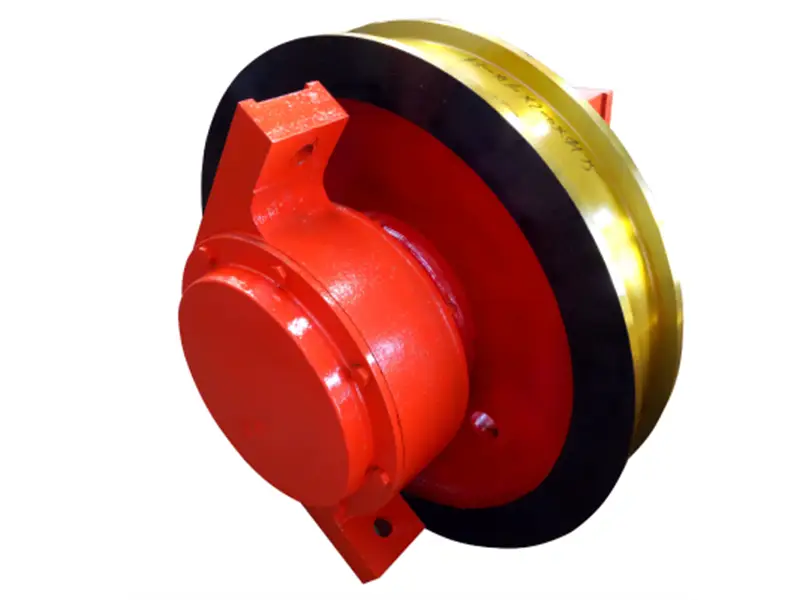
Depending on the equipment design, the drive system may use a motor, gearbox, coupling, shaft, or integrated gear arrangement to transfer power to the wheel.
Drive wheels carry the required operating load while providing traction through contact with the rail.
They are commonly used in:
- Overhead bridge crane travel mechanisms.
- Gantry crane drive systems.
- Port and container-handling equipment.
- Industrial transfer and material-handling systems.
Several factors affect drive wheel performance, including wheel diameter, tread geometry, material, surface hardness, and the connection between the wheel and drive components.
Drive wheels may also have different flange configurations. For example, a crane can use a double-flange drive wheel or a single-flange drive wheel depending on its travel system design.
Idler Wheels (Non-Driven Crane Wheels)
An idler wheel, also called a non-driven wheel, rotates without directly receiving driving torque from the motor or gearbox.
Its primary functions are to support the crane structure and loads, maintain rolling contact with the rail, and follow the movement produced by the driven wheels.
Idler wheels are typically integrated into the crane’s overall wheel arrangement to distribute loads and support stable travel.
Although they do not transmit driving torque, they still need to be designed for the actual wheel loads, operating conditions, and required service life.
Like drive wheels, idler wheels can have different flange configurations according to the crane’s guidance arrangement.
3. Crane Wheels and Wheel Assemblies: What’s the Difference?
When discussing crane wheel products, it is important to distinguish between an individual wheel and a complete wheel assembly.
A crane wheel is the main rolling component that makes contact with the rail. A crane wheel set is a larger assembly that integrates the wheel with supporting and mounting components.
Crane Wheel Sets
A crane wheel set is an assembled unit designed for installation in a crane travel mechanism.
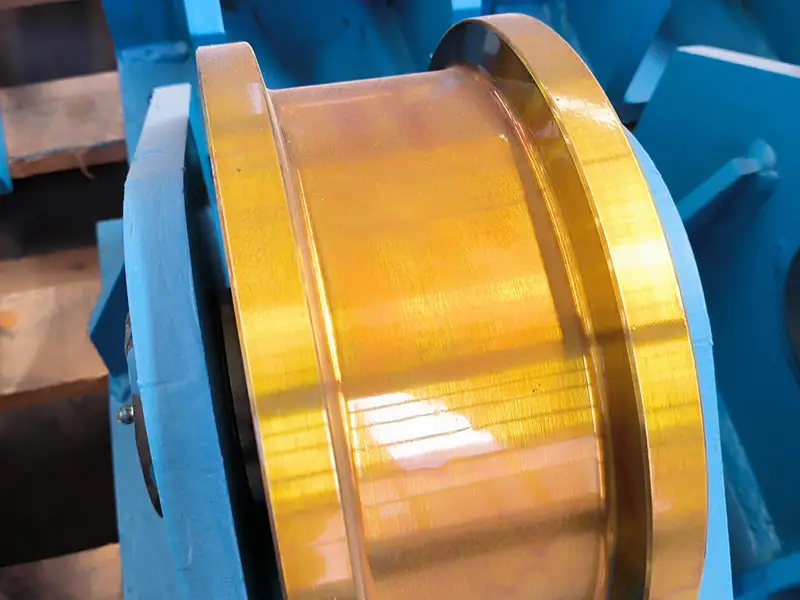
Depending on the design, a wheel set may include:
- One or more crane wheels.
- Axles or shafts.
- Rolling bearings.
- Bearing housings.
- Mounting brackets or supporting structures.
- Drive connection components, where required.
The assembly arrangement varies depending on the crane type, wheel position, load requirements, and maintenance preferences.
Two common bearing-housing arrangements are angle-box designs and split bearing-housing designs.
An angle-box arrangement can allow wheel positioning adjustments during installation or maintenance. A split bearing-housing arrangement uses machined mating surfaces to establish the required assembly position and wheel alignment.
These configurations are selected according to the crane structure and installation requirements rather than treated as interchangeable solutions.
Crane Wheel Bearings
Bearings are essential supporting components in crane wheel systems. They allow the wheel or its supporting shaft to rotate while accommodating the loads transmitted through the assembly.
Depending on the arrangement, crane wheel bearings may need to accommodate radial loads, axial loads, or combined loading conditions.
Common bearing types used in crane wheel applications include:
- Spherical roller bearings: Suitable for applications involving heavy radial loads and potential misalignment.
- Tapered roller bearings: Designed to accommodate combined radial and axial loads.
- Cylindrical roller bearings: Primarily used for radial load applications where their design and mounting arrangement are suitable.
Bearing selection depends on the actual load, rotational speed, shaft dimensions, housing arrangement, lubrication, and operating environment.
The bearing should also be compatible with the wheel assembly’s mounting dimensions and maintenance requirements.
5. Frequently Asked Questions About Crane Wheels
Can Double-Flange Crane Wheels Prevent Crane Skewing?
Not by themselves. Double-flange wheels provide lateral restraint by limiting movement across the rail, but they cannot correct problems caused by uneven drive forces, incorrect wheel alignment, or rail misalignment.
If a crane consistently runs at an angle or shows excessive flange contact, the wheel arrangement, drive synchronization, and runway alignment should be inspected.
Do All Wheels on an Overhead Crane Need to Be Driven?
No. Many overhead crane travel systems use a combination of drive wheels and idler wheels. Drive wheels receive torque from the motor and gearbox, while idler wheels rotate as the crane moves.
The number and arrangement of driven wheels depend on the crane’s travel mechanism, load requirements, and drive system design.
What Causes Excessive Wear on Crane Wheel Flanges?
Excessive flange wear is often associated with repeated lateral contact between the wheel flange and rail head. Common contributing factors include poor rail alignment, incorrect wheel spacing, uneven load distribution, crane skewing, and insufficient flange clearance.
Replacing the worn wheel without identifying the underlying cause may lead to premature wear on the replacement wheel. The wheel and rail contact conditions should be inspected together.
Can Crane Wheels Be Replaced Without Replacing the Entire Wheel Set?
Yes, in some cases. If the existing wheel assembly is designed for individual wheel replacement, a worn wheel can be replaced while retaining serviceable components such as the shaft, bearings, and bearing housing.
However, the replacement wheel must match the original mounting dimensions, bore, tread profile, flange geometry, and material requirements. The condition of the bearings, shaft, and housing should also be checked before reassembly.
Whether individual replacement is practical depends on the wheel set’s construction and the condition of its components.
Looking for Crane Wheels for Your Project?
Whether you need individual crane wheels or complete wheel sets, Glory Rail can help you find a suitable solution for your crane travel system. Share your wheel drawings, rail profile, required dimensions, load conditions, and application details with our team for technical review and a quotation.