
The most obvious difference between single and double flange crane wheels is the number of flanges on the tread. A single flange crane wheel has a flange on one side of the tread, while a double flange crane wheel has a flange on each side.
This difference also affects lateral guidance, wheel arrangement, flange orientation, rail compatibility, and installation requirements. However, double flanges do not automatically mean a crane is safer in every situation, nor can a single flange wheel directly compensate for poor rail alignment or crane skewing.
This article compares single flange vs double flange crane wheels, explaining their structural differences, typical applications, and key replacement considerations. The goal is to help you make the right choice based on the existing equipment design, wheel arrangement, and rail conditions.
1. What Is a Single Flange Crane Wheel?
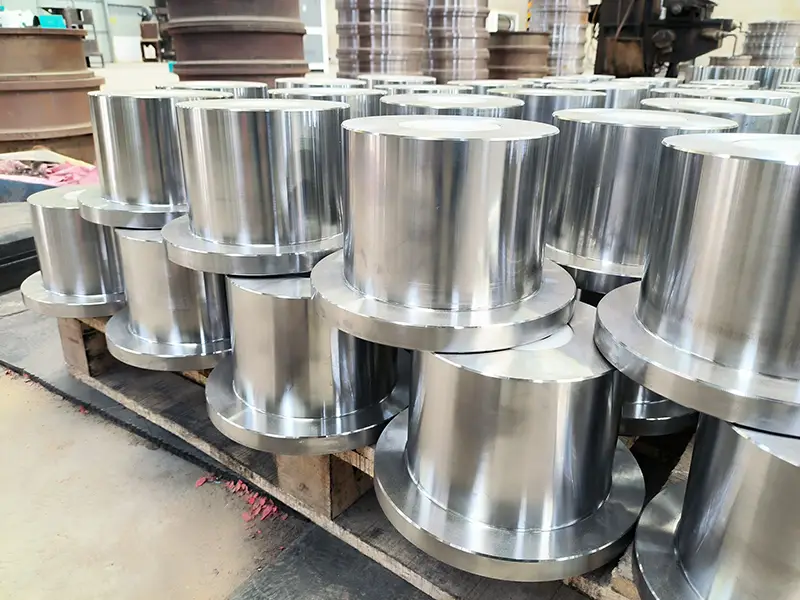
A single flange crane wheel has a raised flange on one side of the tread, while the opposite side remains open. The tread carries the main vertical wheel load, while the flange limits relative lateral movement between the wheel and rail in one direction.
An individual single flange wheel provides lateral restraint on only one side. Whether the complete crane can maintain stable guidance in both directions depends on the arrangement of the other wheels, the corresponding wheel assemblies, or separate guide devices.
For this reason, single flange crane wheels should not be selected based only on wheel diameter and bore size. You also need to check:
- The wheel’s position on the bridge, trolley, or end truck.
- The flange orientation and arrangement of the other wheels.
- Which component provides lateral restraint in the opposite direction.
- The lateral clearance allowed by the original equipment design.
When to Use Single Flange Crane Wheels
When deciding when to use single flange crane wheels, start with the original crane guidance design. A single flange arrangement is generally suitable when:
- The original equipment drawings specifically call for single flange wheels.
- The complete wheel arrangement provides guidance in both directions, rather than relying on each wheel to provide two-way restraint independently.
- There is insufficient space in the surrounding structure to accommodate a second flange.
- A replacement wheel must retain the original flange orientation, tread position, and running geometry.
The open side of a single flange wheel provides more geometric clearance in a specific direction. However, this does not mean the wheel can tolerate improper rail installation, excessive gauge variation, or severe wear in the running mechanism.
Installing the wheel in the wrong position or reversing its flange orientation can still compromise the original guidance arrangement.
2. What Is a Double Flange Crane Wheel?
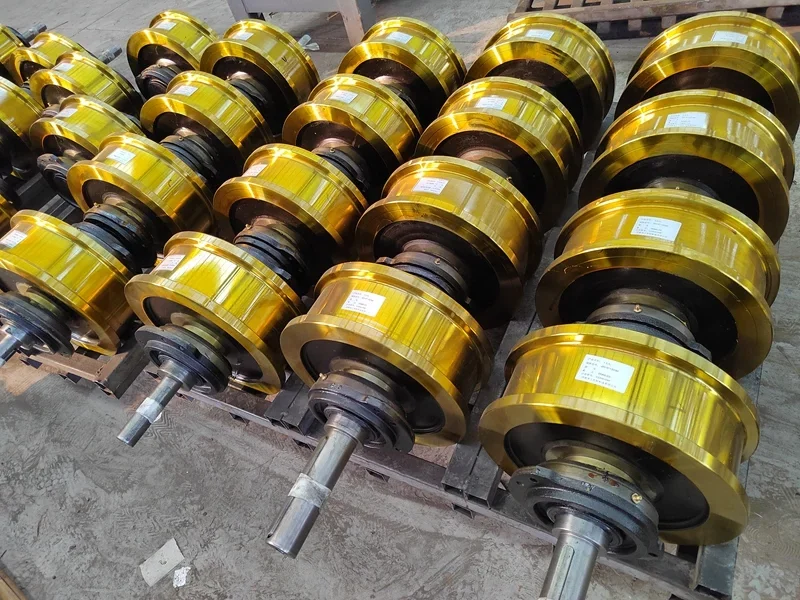
A double flange crane wheel has a flange on each side of the tread, with the rail head running between them. As the wheel moves laterally in either direction, the corresponding flange can approach or contact the side of the rail head. This allows an individual wheel to provide lateral restraint in both directions.
However, effective guidance still depends on correct dimensions and installation. Continuous or excessive contact between the flanges and rail head does not indicate better guidance. It may instead point to insufficient flange clearance, abnormal rail gauge, wheel misalignment, or crane skewing.
When to Use Double Flange Crane Wheels
When deciding when to use double flange crane wheels, check the following conditions:
- The original guidance design requires each wheel to restrict lateral movement in both directions.
- The crane or trolley uses a conventional rail guidance arrangement designed for double flange wheels.
- The rail head dimensions, inside flange clearance, and surrounding mechanical space provide the required clearance.
- Existing double flange wheels need to be replaced with the same specified design.
A heavy-duty or high-capacity application does not automatically require double flange wheels. Load capacity depends on the wheel diameter, effective contact width, tread profile, material, heat treatment, rail, bearings, supporting structure, and relevant design calculations—not simply the number of flanges.
3. Key Differences Between Single and Double Flange Crane Wheels
To understand the difference between single and double flange crane wheels, look beyond the number of flanges. The key question is whether lateral guidance in both directions is provided by an individual wheel or by the complete wheel arrangement.
The following crane wheel flange comparison highlights the main practical differences.
| Comparison | Single Flange Crane Wheel | Double Flange Crane Wheel |
|---|---|---|
| Basic structure | One flange on one side of the tread | Flanges on both sides of the tread |
| Lateral restraint per wheel | Restricts relative movement toward the flanged side | Can restrict relative movement in both directions |
| Dependence on wheel arrangement | Opposite-side restraint may be provided by other wheels or guide devices | Each wheel can provide two-way restraint, but the complete wheel arrangement still matters |
| Installation and space requirements | Flange orientation is critical; the open side may provide clearance for specific layouts | Both flanges must have sufficient clearance from surrounding components |
| Key rail compatibility checks | Flange orientation, tread contact, open-side clearance, and system-level guidance | Rail head width, inside flange clearance, tread contact, and clearance on both sides |
| Possible symptoms of misalignment | Skewing, abnormal contact, and unstable operation | Continuous flange contact, binding, or wear on either side |
| Vertical load capacity | Determined by the overall wheel, rail, and assembly design | Also determined by the overall design; more flanges do not automatically increase capacity |
| Main replacement requirements | Check flange orientation, installation position, dimensions, and original guidance arrangement | Check inside flange clearance, tread geometry, mounting interfaces, and original guidance arrangement |
3.1 The Main Difference Is the Guidance Arrangement, Not Just the Number of Flanges
In a comparison of single vs double flanged crane wheels, a double flange wheel has two potential lateral contact surfaces on the wheel itself. A single flange wheel relies on the complete wheel arrangement to provide the required restraint in the opposite direction.
This is the key point in how flange arrangement affects crane wheel lateral guidance: the flange arrangement determines which wheel or component provides lateral guidance in each direction.
3.2 Double Flanges Do Not Automatically Mean Better Safety or Lower Rolling Resistance
Two flanges can restrict lateral movement in both directions, but they cannot independently eliminate risks caused by excessive lateral loads, wheel-rail mismatch, severe wear, structural deformation, or installation errors.
Likewise, either wheel design may experience increased running resistance if the crane binds, skews, maintains continuous flange contact, develops bearing problems, or has unsynchronized drives.
Safety and running resistance should never be judged by flange count alone.
4. How Rail Design and Wheel Alignment Affect Flange Selection
Rail conditions must be checked together with the wheel flange design.
For double flange wheels, evaluating rail head width and crane wheel compatibility involves checking both tread contact and the clearance between the rail head and the inner flange faces. For single flange wheels, you also need to confirm the flange orientation, open-side clearance, and guidance arrangement of the complete wheel assembly.
Insufficient crane wheel flange clearance may cause frequent flange contact, binding, and wear. Excessive clearance, on the other hand, may allow more lateral movement before the flange engages.
The correct clearance should be based on the equipment drawings, original equipment manufacturer (OEM) requirements, and applicable standards. A generic clearance value from another crane should not be applied without verification.
Continuous flange contact may also be related to rail gauge, rail alignment, wheel diameter differences, wheel installation, or drive synchronization.
Therefore, crane wheel alignment and flange selection need to be considered together. Changing the flange arrangement does not replace the need to identify the cause of crane skewing or abnormal wear.
5. Which Flange Design Is Right for Your Crane?
When carrying out crane wheel flange selection, start with the original guidance design rather than choosing based only on crane capacity or which wheel appears stronger.
Different single flange vs double flange crane wheel applications are essentially based on different guidance and installation requirements.
| Actual Condition | Initial Selection Direction | What Must Be Checked |
|---|---|---|
| Replacement of an existing wheel | Retain the original flange design | Drawings, installation position, dimensions, flange orientation, and rail condition |
| Original equipment uses a single flange wheel arrangement | Single flange | Opposite-side guidance method and flange orientation of each wheel |
| Each wheel is required to provide two-way lateral restraint | Double flange | Inside flange clearance, rail head dimensions, surrounding space, and running clearance |
| A second flange would interfere with surrounding components | Use an OEM-approved arrangement | Actual mechanical clearance and whether an alternative guidance design is required |
| Existing rail wear or crane skewing problems | Diagnose the cause before selecting a wheel | Rail condition, crane geometry, wheel condition, and drive synchronization |
5.1 Checklist Before Replacing Crane Wheels
Before placing an order, prepare the following information:
- Equipment information: Crane or trolley type, manufacturer, model, and travel mechanism.
- Wheel position: Bridge or trolley location, drive or idler wheel, left or right side, and flange orientation for single flange wheels.
- Original drawings: To confirm the flange design, dimensions, material, and mounting interfaces.
- Wheel geometry: Outside diameter, overall width, tread width and profile, flange height and thickness, and the clear distance between the inner flange faces on double flange wheels.
- Mounting interfaces: Bore, keyway, shaft, gear, bearing, and bearing housing.
- Rail information: Rail type, actual rail head dimensions, wear condition, and alignment.
- Operating and fault information: Wheel load, travel speed, duty class, and any reported noise, vibration, binding, skewing, or abnormal wear.
Photos can help identify the wheel design, but they cannot replace dimensional measurements. Wheel diameter alone is not enough to confirm compatibility.
5.2 Final Selection Guidelines
Choose the flange design that matches the original crane guidance system. Use single flange wheels when the wheel arrangement provides guidance in both directions. Choose double flange wheels when each wheel is designed for two-way lateral restraint and sufficient clearance is available.
For replacement projects, follow the original design. Switching between the two types requires checking the entire guidance system.
Learn more about different types of crane wheels, or explore our single flange crane wheels and double flange crane wheels.
For compatibility checks, send us your wheel drawings and rail specifications.
6. Frequently Asked Questions
1. Are single flange crane wheels available in left-hand and right-hand versions? What happens if a wheel is installed in the wrong orientation?
Yes. Single flange crane wheels are available in left-hand and right-hand versions. Mirror-image wheels are not interchangeable because the flange is positioned on only one side.
Installing a wheel in the wrong orientation reverses its intended restraint direction. This may leave one side without proper guidance, cause continuous flange contact on the opposite side, and place abnormal lateral forces on adjacent wheels.
When ordering, specify the left-hand or right-hand version, or clearly mark the flange orientation and installation position on the drawing. Do not select a replacement based on outside diameter alone.
2. Can single flange and double flange crane wheels be used on the same crane?
Only when specified in the original design. Some cranes use different flange arrangements between the bridge and trolley, or between drive and idler wheels.
Do not mix wheel types simply to use available inventory or increase lateral guidance. Uneven lateral restraint between the two sides may cause crane skewing and uneven flange wear.
3. Can I replace only one damaged crane wheel?
For drive wheels, replacement in pairs or as a matched set is generally recommended. Excessive wheel diameter differences within the same travel mechanism can cause uneven travel speeds on the two sides, leading to crane skewing and flange wear.
If only one wheel is replaced, make sure the differences in outside diameter, tread hardness, and flange dimensions between the new and existing wheels are within the allowable limits. Also, recheck drive synchronization.
4. Can crane wheels be custom-made using an old wheel sample without the original drawings?
Yes, but complete dimensional measurements are required. Outside diameter alone is not sufficient.
The measurements should include overall width, tread width and profile, flange height and thickness, flange angle, inside flange clearance, bore and keyway, bearing seats, and mounting interfaces. Also, specify whether the wheel is single or double flange and indicate the flange orientation.
If the old wheel is heavily worn, use unworn areas or mating surfaces to estimate the original dimensions. Photos showing the installation position are also helpful for identifying left-hand and right-hand versions.
5. Can I select crane wheels based on the nominal rail head width if the existing rail is worn?
Not recommended. Wear on the rail head sides changes its actual width and contact position, which may result in excessive or insufficient clearance with a new wheel.
Measure the actual rail head width and rail gauge along the operating section, and check the clearance at the most critical locations.
If the rail is severely worn or the gauge is outside the allowable tolerance, rail repair should be considered before wheel replacement. Otherwise, the new wheels may develop similar wear problems again.