
Rail gnawing in bridge cranes, commonly known as “chewing rail,” is primarily caused by wheel misalignment and lateral sliding. This phenomenon not only shortens the lifespan of both the wheels and rails but also increases operational resistance. In severe cases, it can lead to motor burnout, drive shaft breakage, or even derailment—issues that can compromise the overall integrity of the facility. Drawing on extensive industry experience, this guide examines the causes of rail gnawing, outlines effective inspection methods, and presents targeted repair strategies.
Causes of rail gnawing
1.1 Unsynchronized Drive Mechanisms
When the independently driven left and right wheel assemblies operate out of sync, the crane body tends to skew. This misalignment results in excessive wear as the wheels “chew” into the rails, particularly noticeable during startup and braking.
1.2 Excessive Rail Deviations
- Improper rail alignment can lead to localized damage.
Key factors include:
Inconsistent Rail Span and Linearity: Reduced clearance between the wheel flange and rail side due to deviations in rail spacing or horizontal alignment. - Uneven Rail Elevations: Variations in the relative height of rails or differences between adjacent rails on the same side can induce abnormal contact and wear.
1.3 Structural Deformation
- Bridge cranes are subject to structural deformations that affect wheel alignment:
Span Variations: Deformation of the bridge or trolley structure may cause changes in the distance between wheels or deviations in the diagonal measurements of the wheel assembly. - Vertical Misalignment: Exceeding vertical inclination tolerances during wheel installation can contribute to rail damage.
- Horizontal Bending: Lateral bending of the end beams can induce horizontal misalignment of the wheels. Notably, if wheels on the same side exhibit opposing misalignment directions, their effects can partially counterbalance, a factor that can be leveraged during repairs.
1.4 Incorrect Assembly of Tapered Wheels
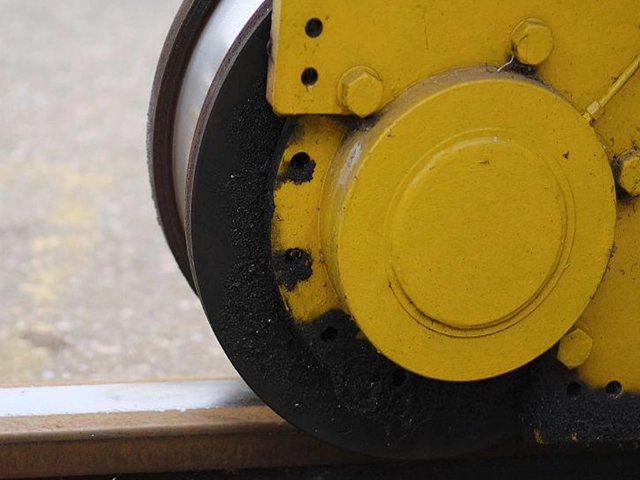
Using centralised drive overhead travelling crane, in order to facilitate self-adjustment of the two ends of the trolley ahead or lagging, usually the trolley active wheel tread are designed for 1:10 taper, and require the two wheels taper in the opposite direction. The assembly error will make the over-advanced more over-advanced, lagging more lagging, leading to the increasingly serious problem of rail gnawing, so the assembly must be strictly check the direction.
(Want to find more quality crane wheels? Click here to learn more!)
Inspection Methods for Detecting Rail Gnawing
Effective detection of rail gnawing can be achieved through several techniques:
- Gap Variation Monitoring:Observe the distance between the wheel flange and rail. Rapid, localized changes during crane operation often indicate damage.
- Visual Inspection:Look for bright marks or burrs on the side of the rail, or for discolored spots on the inner side of the wheel flange.
- Operational Behavior:Notice any tendency for the crane to skew or twist, particularly during startup or braking phases.
- Acoustic Cues:Listen for distinct, loud noises associated with the damage—often an early indicator of severe wear.
Repair Strategies for rail gnawing
3.1 Adjusting the Main Drive System
- Synchronize Drive Assemblies:Carefully adjust the tension and alignment of both drive systems to prevent skewing.
- Motor Speed Calibration:Ensure that both crane motors operate at synchronized speeds, with discrepancies addressed promptly.
- Brake System Optimization:Fine-tune the brake assemblies to achieve balanced force distribution.
- Gearbox and Coupling Maintenance:Regularly inspect and simultaneously replace worn components on both sides.
- Correct Tapered Wheel Installation:Verify that tapered wheels are installed correctly with the larger end facing inward.
3.2 Repairing Small Trolley Issues
- Addressing Rail Span Reduction:Correct deformation under the main beam that reduces the trolley rail spacing by using flame straightening techniques to restore the proper arch of the main beam.
- Ensuring Tolerance Compliance:When using flame correction or rail replacement, ensure that the trolley rail spacing is adjusted within tolerance limits, with appropriate jacking to support the central beam.
3.3 Structural Deformation Repairs
- Targeted Flame Correction:For bridge deformations affecting the vertical diagonal measurements, apply precise flame correction to realign the structure.
3.4 Correcting Wheel Misalignment
- Selective Wheel Adjustment:Analyze and determine which wheel can be adjusted most effectively, prioritizing the adjustment of the driven wheel.
- Balancing Horizontal Misalignment:Utilize the counterbalancing effect of opposing misalignments when adjusting the wheels.
- Jacking and Shim Adjustments:Use a jack to lift the end or balancing beam to free the wheels, then loosen fastening bolts. For minor adjustments, insert shims into the keyway of the bearing housing; for larger corrections, remove the key plate and add shims between the key plate and end beam.
- Vertical Adjustment:Adjust vertical misalignment so that both wheels are angled outward, thereby increasing the contact area with the rail.
3.5 Rail Adjustment on the crane trolley
- Strict Compliance with Technical Standards:Regularly adjust the rail elevation, span, and linearity in accordance with technical requirements, ensuring all bolts are secure.
- Routine Inspections:For heavy-duty or high-capacity cranes, inspect and adjust the rails every six months. For other cranes, inspections should be carried out every six to twelve months to effectively prevent damage.
Conclusion
Proactive management of rail gnawing is critical for ensuring the long-term reliability and safety of bridge cranes. By addressing issues at their source—through meticulous synchronization of drive systems, precise rail alignment, targeted structural corrections, and careful wheel adjustments—maintenance teams can significantly extend the service life of both the wheels and rails. This comprehensive approach not only minimizes downtime and repair costs but also upholds operational safety standards, ultimately contributing to the optimal performance of the entire crane system.
Gldiamond supply crane wheels with High quality& Customised products! Welcome to contact us!