
In a crane hoisting mechanism, the drum assembly is one of the most critical components. Acting as the “power link” of the crane, it enables the lifting and lowering of loads through the winding and unwinding of wire ropes. The drum length design, prevention of wire rope derailment, and scrapping criteria directly affect operational safety and service life. This article provides a systematic and practical analysis of these key aspects.
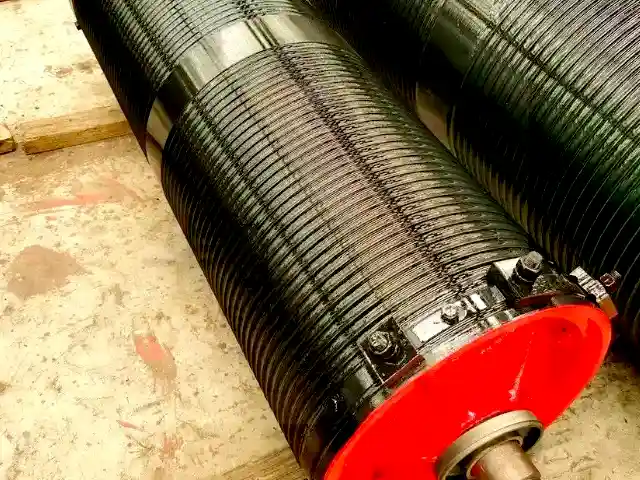
I. Determining the Proper Length of a Crane Drum Assembly
The length of a drum assembly is not arbitrary. It must balance rope anchorage safety, rope service life, and required lifting height, following the principle of adequate safety margin and proportional matching.
1. Core Design Principles
Retention of safety turns
When the hook reaches its lowest working position, at least three full turns of wire rope must remain on each end of the drum. These safety turns reduce the tensile load on the rope anchorage and prevent failure at the fixed end, making them a fundamental safety requirement.
Proper diameter matching between drum and wire rope
The ratio between the drum diameter and the wire rope diameter must comply with applicable standards and consider the crane type (e.g., overhead crane, gantry crane, tower crane) and operating frequency. A reasonable ratio minimizes bending fatigue during winding and significantly extends the wire rope’s service life.
2. Simplified Length Calculation Method
The drum length can be estimated through the following steps:
Determine the rated lifting height and calculate the total wire rope length required to achieve it.
Based on the selected drum diameter, calculate the total number of rope turns on the drum.
Multiply the number of turns by the rope groove pitch (groove width per turn) to obtain the approximate drum length.
II. Wire Rope Derailment: Causes and Preventive Measures
Wire rope derailment (rope jumping out of the drum groove) or misalignment is a common issue during crane operation. It accelerates rope wear and may cause tangled winding, jamming, or even serious safety incidents. The root cause is typically an excessive fleet angle between the wire rope and the drum groove.
1. Common Causes of Derailment
Derailment risk increases significantly when the fleet angle exceeds 4°–6°, or when the rope entry angle becomes excessively sharp. Common contributing factors include:
Insufficient distance between the hook pulley block and the drum, resulting in an overly large rope entry angle.
Misalignment between the pulley block and the drum, causing the rope force direction to deviate from the groove.
Side pulling or diagonal lifting, which introduces lateral forces that force the rope out of its intended groove.
2. Targeted Preventive Solutions
Adjust the installation position of the pulley block to ensure a reasonable distance from the drum and parallel alignment of their centerlines.
Correct any installation deviation to maintain proper rope tracking.
Enforce strict operating procedures and prohibit diagonal lifting, ensuring that the wire rope is loaded vertically or near-vertically to minimize fleet angle.

III. Drum Assembly Scrapping Criteria: Conditions Requiring Immediate Replacement
The drum assembly is a wear-prone component subjected to repeated bending, shear stress, and friction. Once damage exceeds allowable limits, continued use may result in shaft fracture or wire rope failure. The following conditions mandate scrapping or replacement.
1. Cracks in the Drum Shaft
The drum shaft bears bending and shear loads while transmitting torque. Any detected crack, regardless of size, requires immediate scrapping. Cracks propagate rapidly under cyclic loading and may ultimately cause shaft breakage and catastrophic load سقوط accidents.
2. Excessive Groove Wear or Insufficient Drum Wall Thickness
If groove wear depth exceeds 2 mm, re-machining is permissible.
However, after re-machining, the remaining drum wall thickness must not be less than 80% of the original thickness.
If this requirement cannot be met, the drum assembly must be scrapped.
3. Hub Cracks or Loose Connecting Bolts
The drum hub connects the drum body to the shaft. Cracks in the hub compromise structural integrity, while loose or unfastenable connecting bolts may cause vibration, eccentric rotation, or axial displacement. Under such conditions, the drum assembly must be replaced or scrapped.
Conclusion
The length design, derailment prevention, and scrapping management of crane drum assemblies are fundamental to safe and efficient crane operation. By strictly adhering to design principles, controlling fleet angles, standardizing operating practices, and enforcing rigorous inspection and replacement criteria, crane operators can significantly enhance operational safety and extend equipment service life.
Contact us to get more high-quality and customizable crane drum products!