
In factory workshops and port terminals, cranes are the tireless “industrial strongmen” that lift heavy loads and shuttle materials — they are core to production operations. But did you know that this strongman’s “feet” — the wheels — hide many easily overlooked safety hazards? As the travel core of a crane, a faulty wheel not only reduces operational efficiency but can also trigger derailment, overturning and other serious accidents. Below we explain the common faults of crane wheels and how to read their “health signals.”

broken crane wheel
1. The common “tracking” problem: flange wear (wheel gouging)
If you hear continuous scraping or grinding noises while the crane runs, it is likely flange wear — the wheel flange rubbing repeatedly against the rail side. This is one of the most frequent and dangerous wheel faults. It’s like someone habitually walking to one side so their shoe keeps scraping the curb: wasteful and likely to cause a fall.
Causes include incorrect wheel alignment at installation (excessive horizontal/vertical tilt); mismatched drive wheel diameters causing uneven stride; uneven or contaminated rails; deformed crane bridge; or uneven drive forces in the transmission system.
Signs beyond noise include scoring, burrs or metal filings on the rail side or inside the flange, and a visibly deviating running path. Long-term flange wear accelerates wheel and rail deterioration and can ultimately cause derailment or overturning.
2. Worn tread: wheel tread spalling and general wear
The contact surface between wheel and rail is called the tread — like the sole of a shoe. Under repeated heavy loads and impacts, the tread can develop pits, peening, spalling, or wave-like wear.
This problem may arise from insufficient material hardness or improper heat treatment in manufacturing; chronic overloading of the crane; frequent aggressive starts and stops that impose shock loads; or uneven rail surfaces that create localized high stresses.
Consequences include periodic vibration and noise during operation, uneven pressure distribution on the rail, and progressive rail damage — a vicious cycle.
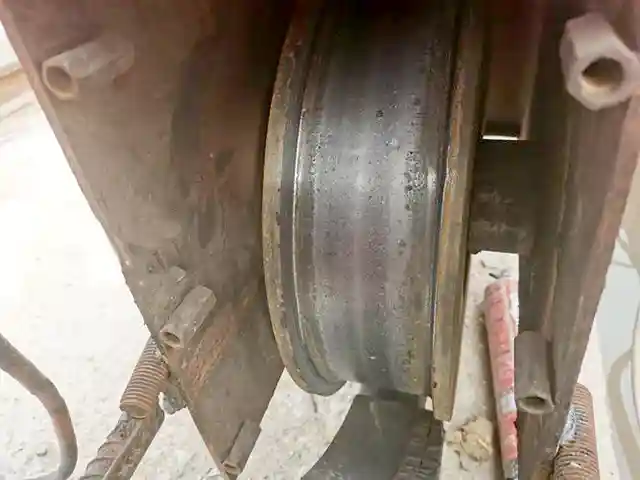
Crane wheel tread spalling
3. Safety barrier compromised: flange cracks and fractures
The wheel flange is the raised edge that acts as a guard against derailment. Flange defects — fine radial cracks or, in severe cases, fracture and detachment — are critical safety failures.
Flange defects commonly originate from material defects (inclusions, porosity) introduced during manufacture; fatigue accumulation from persistent flange rubbing or repeated impact loads; or improper repair practices. For example, inappropriate weld repairs to cracked flanges can embrittle the area and make fracture more likely.
Watch for cracks at the flange root or crown, audible “clacking” as cracks propagate, and fatigue beach marks visible on the fracture surface. If any of these are detected, take immediate corrective action — do not rely on chance.
4. Unstable running: unequal trolley wheel heights
The crane trolley acts like the machine’s arm; its wheels are the small feet. If the trolley runs with noticeable wobble or vibration, or if some wheels appear not to contact the rail, unequal wheel heights are a likely cause — the four trolley wheels are not coplanar, producing lift-off or low contact pressure on some wheels.
Causes include improper leveling during installation, welding or structural distortion of the trolley frame, uneven weight distribution, loose or worn wheel-to-frame connections, or local rail settlement/deformation. If wheel load distribution differs by more than 15%, the trolley’s overturning risk becomes significant and must be addressed.
5. Rotational seizure: bearing failure and hub looseness
Smooth wheel rotation depends on healthy bearings. Bearing failure can cause wheels to seize or even detach, with potentially catastrophic consequences. Bearing degradation is most often due to insufficient or contaminated lubrication; poor sealing that admits dust and moisture; incorrect installation (overly tight or loose fits); or operation under overload or high temperature.
Indicators of bearing failure include increased rotational resistance or stiction, elevated bearing housing temperature, and periodic knocking sounds during operation. Excessive radial or axial play between wheel hub and axle — i.e., hub looseness — also signals urgent attention.
6. Becoming oval: wheel ovalisation
Wheels should be round; after prolonged service they may deform to an oval shape — wheel ovalisation. Causes include chronic overload, accumulated material fatigue, or uneven heat treatment during manufacture that leaves residual stresses that relax under load.
Typical symptoms are pronounced vertical bouncing synchronized with wheel rotation (i.e., vibration frequency tied to wheel speed) and regular indentations or marks on the rail. Continued use of an ovalised wheel accelerates wear on adjacent components and should be avoided.
Crane wheel safety and maintenance checklist
To detect and prevent the faults above, follow this practical guide:
Flange wear (gouging): Use laser distance gauges to measure wheel–rail gap; listen for abnormal noises; regularly correct wheel geometry and verify rail level and alignment.
Tread spalling/wear: Employ ultrasonic testing or visual inspection for pitting and spalling; control crane loads and avoid harsh start/stop cycles; grind or repair tread surfaces as scheduled.
Flange cracks: Use magnetic particle inspection or dye-penetrant testing to find cracks; do not weld-repair cracked flanges — replace them promptly.
Unequal wheel heights: Measure wheel top surface heights with a spirit level or precision level; ensure correct leveling during installation and inspect the trolley frame and wheel mountings regularly.
Bearing failure: Monitor bearing temperature and vibration signatures; grease at scheduled intervals with clean lubricant; replace seals and bearings as soon as contamination or wear is detected.
Ovalisation: Verify wheel roundness with a roundness gauge or by vibration/runout analysis; avoid persistent overload and replace wheels that exceed roundness tolerances.
Crane safety depends on the condition of every component. Wheels may appear small, but they affect the entire system. Regular inspection and timely maintenance will let your “industrial strongman” operate safely and reliably.
Want to purchase high-quality crane wheels to improve industrial efficiency? Contact us!