
In heavy-duty workplaces such as factory floors and port terminals, cranes operate like industrial “strongmen.” The small but critical components that keep those strongmen moving smoothly are the wheels. As the only interface between a crane and its rail, wheels endure sustained heavy loads, friction and impact; wear, cracks and other failures are inevitable over time. When a wheel fails, it can stop crane operations and may lead to tipping, dropped loads and other serious safety incidents.
Because of those risks, replacing crane wheels is not a simple “swap old for new.” It is a high-risk, high-precision maintenance task for special equipment. Below we explain the complete process for crane-wheel replacement and reveal why choosing the right, high-quality wheels makes the job safer, quicker and extends equipment life. Find high quality crane wheels? Click Here!
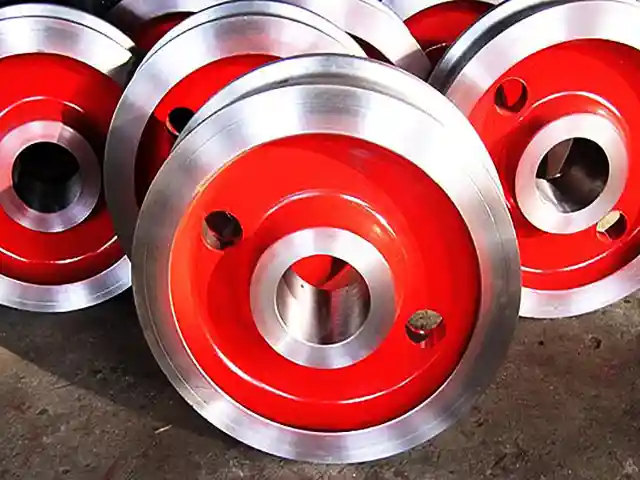
I. Before Replacement — Three critical preparations; do not relax the safety baseline
Safe replacement begins with rigorous preparation. These steps protect personnel and enable accurate installation; selecting correct, high-quality spare parts is central.
1.Lockout-tagout and isolation
Shut off and lock out the crane’s main power supply and affix a clear “Do Not Re-energize” / “Do Not Operate” tag. Secure all motion systems to prevent accidental startup. Establish a perimeter around the work area and assign a dedicated safety observer; prohibit unauthorized personnel from entering the danger zone. This is mandatory for all special-equipment maintenance.
2.Work-window and environment control
Ensure the work surface is level and free of oil or contaminants — an uneven or slippery surface can cause jacks to tip and lead to a side overturn. Perform work only within the ambient range of −20 °C to +40 °C; do not conduct wheel replacement in rain or snow. Moist conditions compromise precision and increase the risk of electric shock.
3.Spare-part verification — the hard criteria for high-quality wheels
The new wheelset is the core of the replacement. Choosing the wrong model or poor quality parts will negate correct procedures. High-quality wheels should meet these key requirements (these are also the competitive advantages of our product line):
Correct model match: the replacement must be the exact model specified for the crane to avoid fit and tracking problems.
Material: prefer 42CrMo alloy steel — it offers high strength and excellent wear resistance under heavy impact; ordinary steels show premature wear.
Machining precision: axle bore tolerance to IT7 accuracy; tread diameter and flange profiles held to tight tolerances; flange type must match track design (SL = double-flange, DL = single-flange, WL = flange-less).
Heat treatment: professional heat treatment producing hardness in the HRC 40–48 range to balance wear resistance without excessive brittleness.
Inspect incoming wheels to confirm no cracks, rust or deformation; only defect-free parts may be installed.
4.Tools and equipment
Do not use non-standard or low-quality tools. Required equipment includes:
Hydraulic jack with rated capacity ≥ 1.5× the single-side wheel load of the crane;
Heavy-duty puller suitable for large wheels;
Torque wrenches with ±2% accuracy;
Laser alignment device with ±0.02 mm probe accuracy;
Dial indicators, feeler gauges and other precision measuring tools;
Copper drift/soft hammer, grease gun and other auxiliary items.
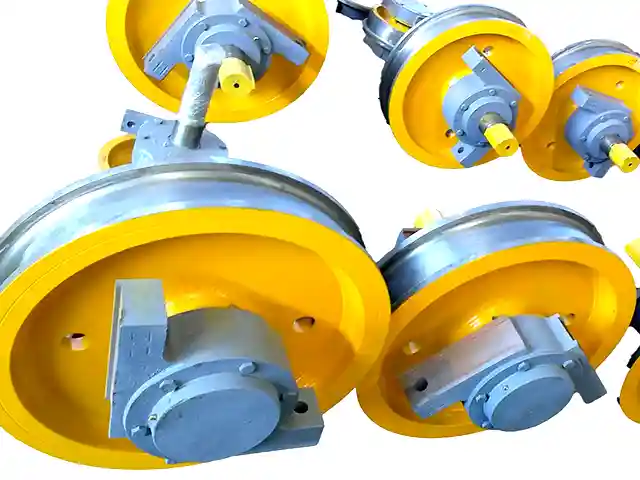
II. During Replacement — Precision at every step; three critical operations you must not miss
The replacement operation is the core procedure. Every action must be steady, accurate and meticulous. Wheel alignment and bolt torquing directly affect future operation.
1.Removing the old wheels — gentle disassembly to avoid secondary damage
First, disconnect drive components: remove the gearbox/coupling bolts at the drive end (mark original positions for reassembly), and use a proper puller to remove the coupling half; do not pry on the shaft to avoid damaging journal surfaces. Then, jack the bridge evenly until the wheel tread is 10–15 mm above the railhead so wheels can be moved laterally. Loosen high-strength bolts connecting bearing housings to the end girder in a diagonal pattern, use prying only as needed, and remove the wheelset by sliding it along the rail direction — avoid scraping the rail.
2.Installing the new wheels — accurate alignment is essential for smooth operation
Bring the new wheelset to the rail and confirm the flange orientation (double flanges inward, single flange outward). Insert the wheelset into position and hand-start the mounting bolts. The critical alignment checks that follow determine whether the wheels will track properly or produce flange contact and rail damage:
Horizontal alignment: use a laser alignment tool to ensure the tread centerline deviates ≤ 2 mm from the rail centerline (per GB/T 10183.1-2018).
Vertical alignment: measure the angle between the wheel plane and the rail vertical; allowable deviation ≤ 0.00167 × gauge (per GB/T 10183.4-2010).
Diagonal-distance check: measure center-to-center diagonal distances for opposing wheels; allowable deviation ±5 mm to ensure synchronized rotation of all four wheels.
For drive wheels, replace them in matched pairs. Perform coupling alignment by adjusting the motor base plate shims so that radial runout ≤ 0.05 mm and axial offset ≤ 0.04 mm per meter (per JB/T 8853-2015); correct alignment prevents transmission vibration and gear reducer damage.
3.Bolt tightening and final inspection — details determine safety
Tighten bolts in a cross pattern in three stages: 50% preload, 80% preload, then 100% final torque. Observe manufacturer torque specifications for high-strength bolts (example ranges: M24 ≈ 800–900 N·m; M36 ≈ 2200–2500 N·m); always use calibrated torque wrenches.
Final checks:
Manually rotate wheels to confirm freedom of movement, absence of binding and abnormal noise.
Under load, confirm uniform contact across the wheel tread with the rail and no wheel lift.
Conduct a 5-minute no-load run; the crane should run smoothly with no vibration or flange-to-rail rubbing.
III. Special-case wheel replacements — targeted procedures; high-quality wheels reduce labor
Different wheel types require different emphasis during replacement. High-quality designs substantially reduce installation complexity.
Double-flange wheels (SL): precise flange dimensions on quality wheels normally require only a uniform inner-side clearance of 2–4 mm to prevent flange rubbing.
Drive (active) wheels: must be replaced in matched pairs. High-quality drive wheels with tread diameter error ≤ 1 mm simplify synchronization and reduce alignment work.
Flange-less wheels (WL): intended for high-precision tracks only. With a high-flatness tread and, if necessary, a track recheck (track gauge tolerance ≤ ±3 mm), high-quality flange-less wheels can run stably.
IV. After Replacement — acceptance, documentation, and how quality wheels extend service life
Replacement is not complete until formal acceptance and recordkeeping are finished. Complete a “Crane Wheel Replacement Record” documenting date, wheel identifiers, old/new wheel parameters, alignment data and torque values. Per TSG 51-2023 (Crane Safety Technical Regulations), have a certified special-equipment inspection body supervise and inspect the work; only return the crane to service after passing inspection.
Selecting the right high-quality wheels not only makes the replacement easier but also significantly extends service life and reduces subsequent maintenance costs. Our crane wheels are manufactured to industry standards from 42CrMo material, with precision machining and professional heat treatment. We offer SL, DL and WL flange types and precise match for a wide range of crane models to ensure safe, reliable operation.
If your facility is dealing with worn wheels or repeated replacement challenges, consider our premium crane wheel products. Our experienced application engineers will provide customized selection and support so your cranes run longer and safer. Contact us for More about Crane Wheels details!