
Since the second half of 2025, China’s high-speed rail materials sector has reported a set of milestones: at the core production base for rare-earth steel rails in Baotou, Inner Mongolia, the world’s only mass-produced 400 km/h rare-earth steel rail has entered volume supply to major domestic high-speed projects.
At the same time, the first batches of high-strength, heat-treated rare-earth rails that meet European standards have begun to ship overseas in volume. The combined “domestic deployment + international export” achievement not only signals that China’s rail technology has reached a new scale of application for high-speed service, but also reshapes global competition in high-speed rail steel through demonstrable manufacturing strength.

Core technical advances — rare earths raise the performance bar
Conventional rail steels have long been constrained by fatigue fracture and low-temperature brittleness — key obstacles to higher operating speeds. Leveraging China’s unique rare-earth resource advantages (notably Baiyun-Ebo deposits), R&D teams refined the “rare-earth + steel” innovation pathway. Building on prior micro-alloying approaches, the fourth-generation rare-earth rail shows comprehensive improvements that place it at the domestic leading edge.
Key metallurgical upgrades
Precision reshaping of non-metallic inclusions: Rare-earth elements, primarily cerium (Ce), react selectively with sulfur and oxygen in the steel to convert sharp, crack-prone plate-like MnS inclusions into uniformly dispersed, spherical Ce₂O₃ / Ce₂O₂S composite particles with particle sizes ≤ 1.5 μm. The result is substantially reduced stress concentration and crack initiation risk.
Grain-boundary strengthening: Directional segregation of rare-earth atoms at grain boundaries inhibits aggregation of harmful elements such as sulfur and phosphorus. Combined with improved control of metallurgical cleanliness, this raises bulk toughness and significantly improves low-temperature resistance to brittle fracture.
New performance thresholds: Advances in dimensional-accuracy control raise longitudinal straightness by 20%, achieving millimetre-level control. Fatigue crack-initiation life is extended by more than 40% relative to conventional rails — equivalent to an additional ~100,000 km of service without fatigue damage — enabling reliable operation at 400 km/h.
Proven under extreme conditions — validated across full scenarios
The upgraded rare-earth rails have completed validation across a broad range of demanding service environments, from ultra-high speed to heavy-haul lines. Recent in-service data from heavy-traffic routes further demonstrate the technology’s versatility.
Representative applications and performance
Domestic under-construction ultra-high-speed line (2025 supply): Designed for 400 km/h and high daily frequency — all performance indices meet requirements and provide core support for safe, stable operations.
Shuohuang heavy-haul line (75 kg/m rail): High axle loads and traffic volumes; after 18 months in service carrying total tonnage ≈ 510 million tonnes, no significant fatigue damage observed; wear rate is low and operational efficiency has improved.
Baoyin (Baotou–Yinchuan) in the Mu Us Desert: Windblown sand abrasion and diurnal temperature swings >50°C; continuous operation for three years without replacement, with rail-head wear down ~30% and maintenance cycles extended.
Yanshan mountain section (e.g., Beijing–Zhangjiakou corridor): Severe cold and heavy snow with 350 km/h frequent operation; longitudinal straightness error ≤ 0.15 mm/m, delivering extremely stable running performance.
Notably, the newly developed 75 kg/m high-strength, high-wear-resistance heat-treated rare-earth rail has passed the CRCC technical review and is positioned to address contact fatigue and high-wear issues on the world’s largest heavy-haul corridors (for example, lines comparable to the Datong–Qinhuangdao/Daqin type corridors).
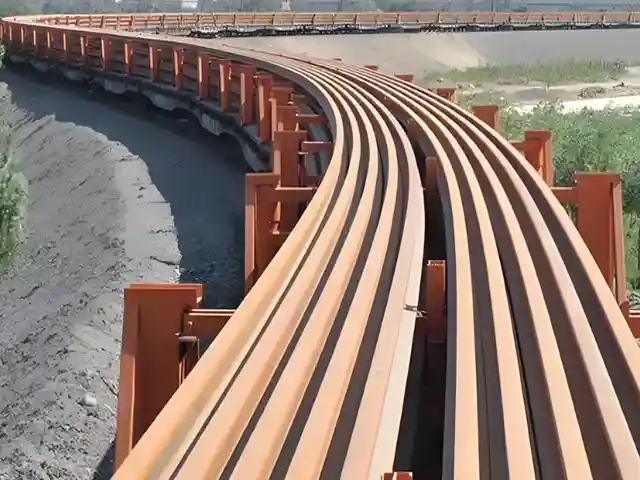
Global market breakthrough — Chinese standards go abroad, premium market entry
The product’s technical strengths have won international recognition. In 2025 the program achieved a critical international milestone: in addition to continued conformity with CRCC (China), TSI (EU) and KSR 5101 (Korea), the first batches of EU-standard, high-strength heat-treated rare-earth rails were exported in volume — marking China’s entry into Europe’s high-end rail market.
Current market footprint and competitive position
Exports and deployments now include South Korea, Australia and multiple Belt-and-Road projects (e.g., Hungary-Serbia, Laos–China).
Through 2025, no European or North American producer had achieved comparable mass production of rare-earth steel rails; Japan continues to follow traditional standards. China’s leadership in ultra-high-speed and heavy-haul rail steels has therefore widened.
Domestic market share of rare-earth rails exceeds 30%; cumulative laid mileage is equivalent to approximately one-third of the Earth’s circumference, making these rails a core material for China’s “Eight Vertical and Eight Horizontal” high-speed network.
End-to-end intelligent manufacturing and service system
Large-scale deployment is underpinned by intelligent upgrades across the entire industrial chain. Leading firms and partners have constructed an integrated “front-end precision feed + back-end high-efficiency integration” service system that secures production and application.
Selected systems and capabilities
Automated joint alignment production lines: Butt-joint alignment precision reaches ±0.1 mm/m and production efficiency improved ~30%, ensuring quality for long continuous track laying.
100-meter continuous rail welding: 500 m continuous welded rails show weld toughness up to 95% of base metal with longitudinal straightness deviations controlled to 0.18–0.20 mm/m.
Extreme maintenance throughput: A closed-loop “remove-stretch-weld-adjust” workflow for 400 m of rail can be completed in 240 minutes, resetting industry standards for maintenance efficiency.
Conclusion — iterative innovation accelerates global leadership
From mass production for 400 km/h service to successful EU-standard exports, and from ultra-high-speed lines to heavy-haul corridors, the rare-earth rail’s breakthroughs illustrate China’s shift from “fast follower” to global leader in high-end rail materials.
Building on the “rare-earth +” strategy, R&D teams are already pursuing a fifth-generation rail with higher toughness and corrosion resistance, targeting 450 km/h capability and lifecycle carbon footprint management. These developments position rare-earth rails as a high-quality, exportable Chinese solution for the ongoing global upgrade of rail infrastructure.
Contact us for more high quality rails now!