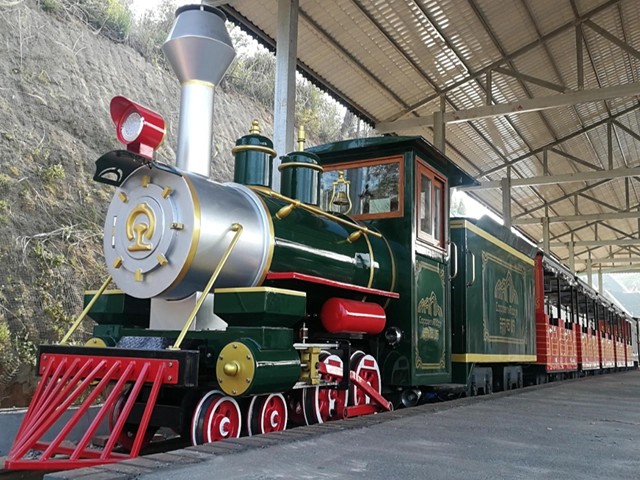
In recent years, scenic railways have become a powerful guest-attraction engine for parks and destinations—connecting dispersed attractions, reducing visitor fatigue, and creating an immersive sightseeing experience. We recently designed and delivered an approximately 3.2 km scenic railway system for a mountain-agricultural park that spans flat promenades, steep hillside trails, and family interaction areas. This project emphasizes a fit-for-purpose, terrain-driven selection of rail profiles and demonstrates how an integrated supply + installation approach can simplify delivery and reduce long-term operating costs. (Note: specific schedule and cost figures cited in this case come from project estimates; owners should obtain independent verification and site surveys before committing.)
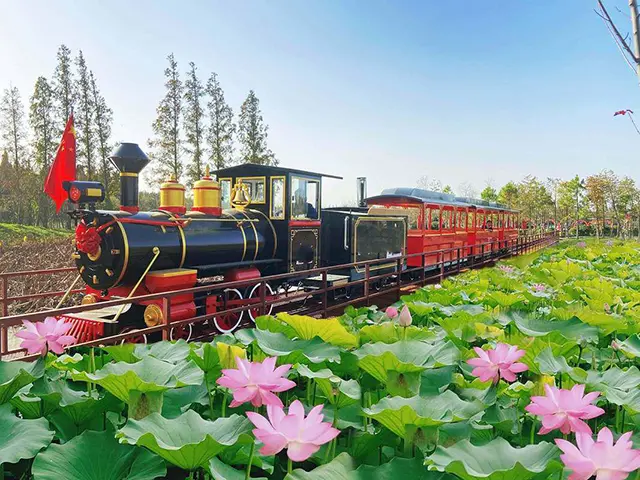
Project Overview — 3.2 km, multiple terrain types, strong need for “universal + customized” solutions
The park covers roughly 18 Hectares and includes four main zones: floral fields, mountain boardwalks, a family farm area, and a folk-village. Terrain varies significantly between attractions:
- Entrance → Floral Fields: ~1.5 km, flat, paved concrete paths.
- Family Farm ↔ Folk Village: ~0.8 km, gentle grade (≤ 3%).
- Floral Fields → Mountain Boardwalk: ~0.9 km, with consecutive curves and short steep sections (about 4–5% grade, minimum curve radius ≈ 15 m).
The client’s primary concerns were: (1) how to balance lightweight rail (economical, fast to install) with heavier rail (higher load capacity for hillside sections), and (2) how to source a complete, compatible package (rails plus fastenings, pads, turnouts and installation) from a single provider to avoid multi-vendor incompatibilities. To meet these needs they chose our turnkey solution—covering rail profiles from 15 kg/m to 43 kg/m, galvanized baseplates, rubber pads, corrosion-resistant fasteners and custom turnouts—enabling “right material in the right place.”
Tailored solution by terrain — balancing safety, guest experience and cost
1. Flat promenades (1.5 km) — light rail for economy and long runs
This section is a low-speed connection (design speed ≤ 8 km/h) intended to support a 12-seat sightseeing train (estimated gross weight ~3.5 tonnes). We recommend 15 kg/m rail as the baseline with 22 kg/m used at entry/transition points:
- Why: lighter rail reduces material and installation costs and can be laid with small-scale machinery; ideal for low-load, long-distance runs.
- Accessories: hot-dip galvanized baseplates and rubber pads for vibration isolation and corrosion resistance help maintain garden tranquility.
Note: final rail selection should be confirmed by structural checks that include vehicle weight, axle loads, speed and traffic density.
2. Family interaction area (~0.3 km loop) — medium light rail for smooth stops and high-frequency operation
The family area is designed for low speeds (~5 km/h) with frequent start/stop and many turns. 24 kg/m rail is recommended here: wider head profile and improved toughness make it more resilient to repeated braking and acceleration. Use 12 mm thick rubber pads and a simple, robust turnout design to improve ride comfort and operational safety for families.
3. Mountain slopes (0.9 km) — 30 kg rail with 38 kg reinforcement at critical points
The mountain section presents the biggest engineering challenge: multiple curves and short steep grades (~4–5%). Our recommended approach:
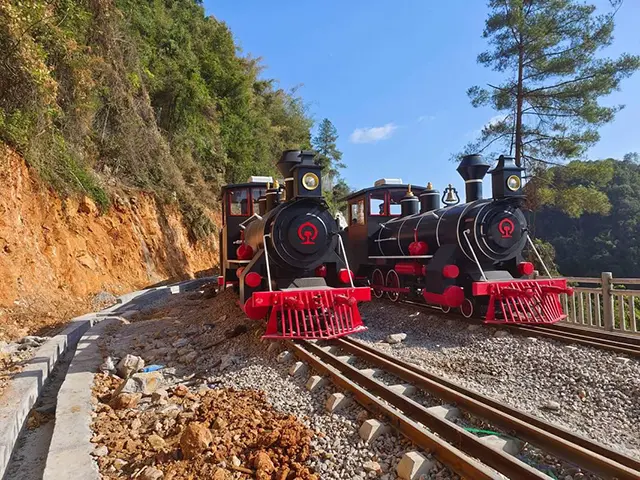
- Use 30 kg/m rail for the primary running line—this provides higher tensile strength suitable for traction stresses on grades—installed on a well-compacted graded ballast substructure (compaction ≥ 96%) to distribute loads.
- At critical locations (top of slopes, outer edges of tight curves), splice in 38 kg/m rail to strengthen local bearing capacity and reduce long-term deformation risk.
- All joints should use corrosion-resistant bolts and elastic baseplates; we recommend torque-controlled fastening during installation and a documented tightening record (example torque: 350 N·m) with an early operating inspection schedule.
Note: transitions between rail profiles require close attention to rail alignment and geometry control to avoid localized wear.
4. High-use attraction zones (0.5 km) — 43 kg heavy rail for frequent stops and passing loops
Around the main viewing platform—where trains stop frequently and passing maneuvers occur—install 43 kg/m heavy rail on C30 concrete sleepers (approx. 600 mm spacing) to ensure long-term stiffness and ride quality. Use custom turnouts (DK630 series or equivalent) matched to 43 kg rail for reliable, wear-resistant switching.
Accessories & construction best practices
- Baseplates: hot-dip galvanized or higher for outdoor corrosion resistance.
- Rubber pads: choose compound high quality type with stable rebound properties; consider thicker pads at family areas.
- Fasteners: corrosion-resistant bolts with anti-skid features; torque control during installation and periodic retightening during early operation.
- Ballast & subgrade: crushed graded ballast with design compaction in mountain sections to achieve load distribution and drainage.
- Quality control: measure and record track geometry (gauge, alignment, surface profile), sleeper spacing and fastening torques as part of acceptance testing.
Delivery outcomes & operational observations
Following handover, the park experienced an increase in daily passengers, strong satisfaction in the family area, and effective noise control in the floral fields. Reinforcement with heavier rail in mountain critical points has contributed to stable operation.
Why more parks opt for tailored, one-stop track solutions
- Right sizing: selecting rail types from 15 → 43 kg/m allows each segment to be optimized for load and use, avoiding over-specification or under-performance.
- Single-source compatibility: delivering rails, baseplates, pads, fasteners and turnouts together reduces adaptation risk.
- Lower lifetime cost: appropriate design and clear maintenance procedures help keep long-term upkeep manageable.
- Guest experience: well-executed damping and noise control preserve scenic assets and improve satisfaction.
Important notes & recommendations
- Data provenance: project timing and percentage improvements cited are project/vendor estimates and will vary by site, climate and project management—treat them as indicative, not guaranteed.
- Pre-contract requirements: owners should require detailed site surveys, structural rail calculations, vehicle compatibility checks, and a full construction plan (including environmental and safety measures) before awarding contracts.
- Contract & maintenance terms: specify acceptance criteria (track geometry tolerances, recorded torque logs, successful trial runs) and define warranty/maintenance schedules.
- Independent review: for cost and schedule commitments, consider third-party supervision or a cost consultant to reduce execution risk.
About Us / How We Can Help
We provide turnkey scenic railway solutions—from feasibility and site surveys through design, supply and on-site installation to commissioning and maintenance plans. Our service package includes a full range of rail profiles (15–43 kg/m), sleepers (timber or concrete), corrosion-resistant baseplates and fastenings, elastic rubber pads, and custom turnouts matched to your track sections and operational needs.
What we offer:
- Free on-site survey and tailored routing & rail-type recommendations.
- Production and delivery of rails and all accessories sized to your terrain.
- On-site installation supervision, quality control, and commissioning.
- Operator training and maintenance schedules to keep your system running smoothly.
Contact us to arrange a no-obligation site survey and a customized proposal that balances safety, guest experience and lifecycle cost.