
When you ride a high-speed train, have you ever wondered how the train’s weight is distributed evenly to the track beneath? In a factory workshop, how does a heavy crane avoid damaging the floor? The answer in both cases often lies in a small component: the steel bearing plate. Although railway bearing plates and crane plates may look like a simple piece of steel, they are actually custom-designed for very different roles — and even if both types are placed side by side, you can readily tell them apart.
Below we use the most direct, visual approach to help you decode the “identity markers” of these two types of steel plates.
Want high quality steel plates for your project? Click HERE!

First look at appearance: the most immediate distinguishing features
Like professionals in different occupations wearing different uniforms, the two types of bearing plates have very noticeable differences in appearance. This is the easiest way to identify them.
Railway steel plates: “customized saddles” with a slight inclined slope
If you see a steel plate whose surface contains a groove that precisely matches the underside of a rail — and the groove is not flat but has a slight incline — it is very likely a railway bearing plate. That incline is not arbitrary; it conforms to the industry-standard 1:40 rail base slope — that is, 1 mm of height difference for every 40 mm of horizontal length. Think of it as a small anti-slip cushion that helps keep the rail seated correctly so that train wheels bear their loads centrally and are less prone to lateral creep.
Railway steel plates also typically have small, symmetrically arranged holes on both sides to align with pre-drilled fixtures on the rail sleeper (tie) and secure the plate in place. Some plates include small retaining flanges at the edges to prevent lateral movement of the rail — a critical safety measure when high-speed trains are running, because even small shifts can be dangerous.
Crane Rail plates: two “body types,” both minimalist and functional
Crane bearing plates come in two main forms, and neither has the slope or deep saddle grooves found on railway plates; they follow a simpler, utility-focused design.
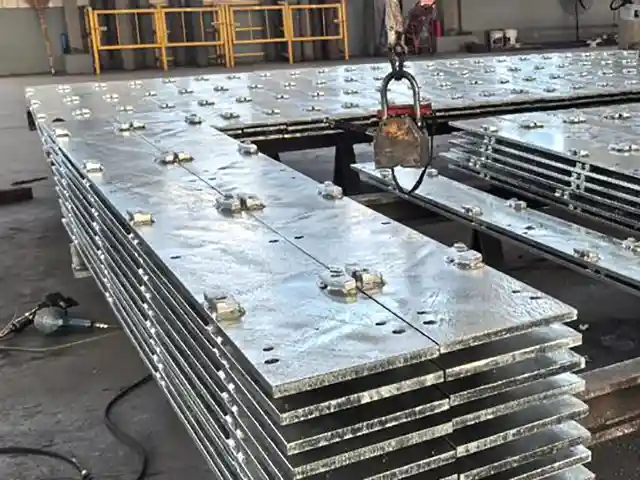
One form is the rail-base plate used between the crane rail and the building’s crane beam. These can be long strips laid along the rail or segmented blocks spaced to match wheel intervals. Their surfaces are either flat or have only shallow grooves. The holes in these plates are arranged along the rail direction and are used to fasten the plate to the crane beam; the hole spacing tends to be regular.
The other form is the outrigger (support-leg) pad, which is very simple — a square or rectangular flat plate without holes, laid directly between the crane outrigger and the floor. These pads are characterized by being large and thick: their area is commonly at least three times the actual contact area of a support leg, and the thicker the pad, the higher the crane’s rated capacity it can support (for example, for cranes in the tens-of-tons class, pad thickness is commonly at least 30 mm). The purpose is to enlarge the contact area and prevent the crane from damaging the floor.
Then look at the job: core functional differences
The differences in appearance reflect their different operational roles — one must handle high-speed, repetitive dynamic loads, while the other must withstand heavy static and impact loads.
Railway steel plates: cushioning and positioning specialists for high-speed trains
Railway plates have three primary functions: (1) distribute the train’s weight evenly to the sleeper (tie) to avoid local overloading of the rail; (2) use the 1:40 slope to help maintain stable running and reduce lateral deviation at speed; and (3) secure the rail together with associated fastenings, while providing some degree of electrical insulation — important because track circuits and signalling depend on controlled electrical continuity, and short circuits can disrupt signals.
They are designed to resist the repetitive dynamic loading of passing trains — essentially countless cycles of heavy downward force and rebound. For this reason they are often bonded to rubber pads to add elasticity and reduce vibration.
Crane bearing plates: load-bearing and anti-slip defenders for heavy lifting
Crane plates have a more direct role: either to distribute the wheel loads of the crane to the crane beam (rail-base plates) or to spread outrigger loads to protect the floor (outrigger pads). Crane operation often involves heavy static loads or sudden impact during starting and stopping, with significant lateral forces, so these plates prioritize strength and wear resistance over elasticity.
In corrosive environments such as ports or steel mills, crane plates are often treated for corrosion resistance. Outrigger pads sometimes have anti-slip textures on the surface to prevent sliding during operations.
Three quick steps to tell them apart on site
If you encounter these plates in the field, remember three simple checks to identify them instantly:
Check for the slope: a 1:40 inclined saddle → railway use; flat, no slope → crane use. (This is the most decisive indicator.)
Check for a deep matching groove: a deep groove matching the rail profile → railway use; shallow grooves or flat surface → crane rail-base plate; completely flat → crane outrigger pad.
Check for symmetric small holes: symmetrically placed small holes on both sides → railway use; holes arranged in one direction along the rail → crane rail-base plate; no holes → crane outrigger pad.
Small parts, big impact: the invisible foundation of safety
One might dismiss bearing plates as “just a small steel plate under something,” but in practice they are the invisible foundation of safe operation. The slope and alignment features of railway plates ensure the smooth, safe running of high-speed trains; the large area and high strength of crane pads prevent heavy machinery from crushing the ground.
Although they may look similar at first glance, these steel components are engineered very differently to match their specific roles — a clear example of “custom design” in engineering and a reminder that in industrial systems, attention to detail determines safety.
Find more high quality rail accessories, Welcome to contact Us!